Description
Form
climber, perennial, deciduous
Height: Climbs to 20–30 m
Flower colour
PurpleBlueWhite
Flowering
April–May
Habitat
Leaves
Odd-pinnate leaves 10–30 cm long with 7–13 oblong, glossy leaflets.
Flowers
Purple, blue-violet or white pea-like flowers in hanging clusters 15–20 cm long; all the flowers in a cluster open together and smell like grapes.
Fruit and seeds
Flat, brown, velvety pods 5–10 cm long holding disc-shaped seeds about 1 cm across; they twist open when dry.
Classification
- KingdomPlantae
- PhylumTracheophyta
- ClassMagnoliopsida
- OrderFabales
- FamilyFabaceae
- GenusWisteria
- SpeciesWisteria sinensis
Native range
According to POWO it is native only to China (north-central, south-central and south-eastern China). It is grown as an ornamental throughout temperate regions.
Growing conditions
Light
Full sun; flowers poorly in shade.
Water
Moderate.
Soil
Fertile, free-draining soil.
Temperature
Hardy.
Twines anticlockwise; it becomes very heavy and needs a strong support. According to Turkish Wikipedia it can live for 70–80 years.
Culture and history
Its Japanese relative
Japanese wisteria (Wisteria floribunda) forms longer clusters and twines clockwise; Chinese wisteria has shorter but more numerous clusters.
Toxicity
ASPCA lists wisteria as toxic to cats, dogs and horses; the toxins are a lectin and wisterin glycoside. Signs are vomiting (sometimes with blood), diarrhoea and depression. According to Wikipedia all parts are poisonous, and the seeds especially can cause nausea, vomiting, stomach pain and diarrhoea in children.
In an emergency call your local poison centre; for pets, contact a vet straight away. See also: plants and pets.
Look-alikes
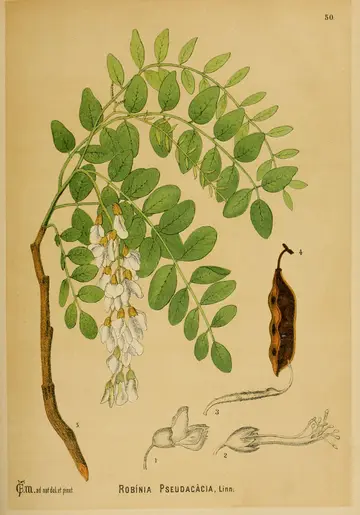
- Black locust: Also has hanging clusters of pea-like flowers, but it is a tree and its flowers are white. Compare side by side →
- Common lilac (Syringa vulgaris): Its flowers also come in fragrant purple clusters, but the clusters stand upright and are pyramid-shaped, and each small flower is a tube with four lobes. Lilac is a shrub, not a climber, with simple leaves in opposite pairs; wisteria has pinnate leaves, hanging clusters and pea-like flowers. Compare side by side →
Questions
Is wisteria poisonous?
Yes. ASPCA lists it as toxic to cats, dogs and horses; all parts are poisonous, especially the seeds.
Why won't my wisteria flower?
Usually because it gets too little sun or is pruned at the wrong time; plants grown from seed can also take many years to flower.
Chinese wisteria: when does it flower?
In spring: April–May. Months are for temperate northern-hemisphere climates and shift with altitude and weather.
Chinese wisteria: how do you grow it?
Light: Full sun; flowers poorly in shade. Water: Moderate. Soil: Fertile, free-draining soil. Temperature: Hardy. Twines anticlockwise; it becomes very heavy and needs a strong support. According to Turkish Wikipedia it can live for 70–80 years.
Chinese wisteria: what is its scientific name?
Wisteria sinensis (Sims) DC., in the genus Wisteria and the family Fabaceae.
Sources
- Wikipedia: Wisteria sinensis
- ASPCA Animal Poison Control: Wisteria
- World Flora Online
- Plants of the World Online (Kew) · native range (WCVP)
- GBIF · classification
- Wikidata
Checked: 2026-11-17. Spotted a mistake? Tell us.