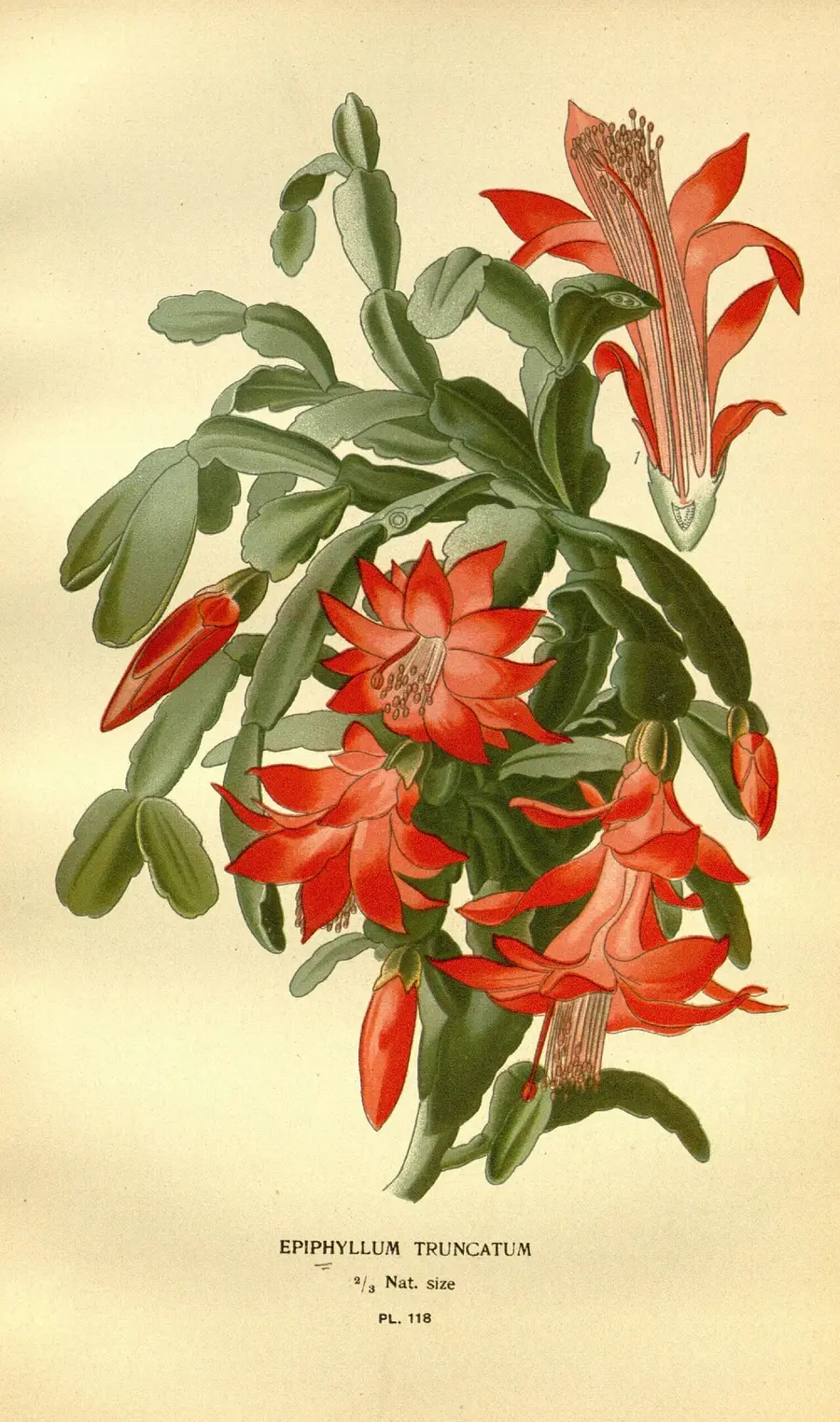

Description
Form
epiphytic cactus, perennial
Height: 20–40 cm, trailing
Flower colour
PinkRedWhitePurpleOrange
Flowering
November–January
Habitat
Leaves
No true leaves; flat, toothed, jointed stem segments.
Flowers
Tubular flowers with swept-back petals at the stem tips, in pink, red, white, purple or orange.
Fruit and seeds
Small red berries.
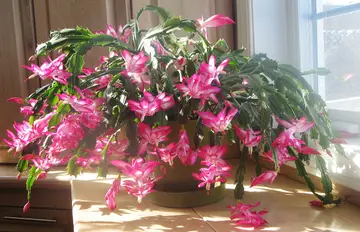

Classification
- KingdomPlantae
- PhylumTracheophyta
- ClassMagnoliopsida
- OrderCaryophyllales
- FamilyCactaceae
- GenusSchlumbergera
- SpeciesSchlumbergera truncata
Native range
According to POWO it is native to southeastern Brazil, where it grows as an epiphyte in the humid forests of the coastal mountains around Rio de Janeiro.
IUCN Red List status: Vulnerable (VU).
Care
Light
Bright, indirect light.
Water
Keep lightly moist during growth and flowering; reduce for a few weeks after flowering.
Soil
Free-draining, humus-rich mix.
Temperature
15–24 °C. Cool nights (10–15 °C) and short days in autumn trigger buds.
Moving the plant while in bud can make it drop its buds.
Toxicity
ASPCA lists the Christmas cactus (entry under Schlumbergera bridgesii) as non-toxic to cats, dogs and horses.
In an emergency call your local poison centre; for pets, contact a vet straight away. See also: plants and pets.
Questions
Is the Christmas cactus safe for cats?
Yes. ASPCA lists it as non-toxic to cats, dogs and horses.
Christmas cactus: when does it flower?
In autumn and winter: November–January. Months are for temperate northern-hemisphere climates and shift with altitude and weather.
Christmas cactus: how do you care for it?
Light: Bright, indirect light. Water: Keep lightly moist during growth and flowering; reduce for a few weeks after flowering. Soil: Free-draining, humus-rich mix. Temperature: 15–24 °C. Cool nights (10–15 °C) and short days in autumn trigger buds. Moving the plant while in bud can make it drop its buds.
Christmas cactus: is it toxic to cats and dogs?
Non-toxic to cats and dogs. Non-toxic.
Christmas cactus: what is its scientific name?
Schlumbergera truncata (Haw.) Moran, in the genus Schlumbergera and the family Cactaceae.
Sources
- ASPCA Animal Poison Control: Christmas cactus
- Wikipedia: Schlumbergera truncata
- World Flora Online
- Plants of the World Online (Kew) · native range (WCVP)
- GBIF · classification
- Wikidata
Checked: 2026-11-16. Spotted a mistake? Tell us.