Telling them apart
Chinese wisteria vs Common lilac
Chinese wisteria (Wisteria sinensis) and Common lilac (Syringa vulgaris) look similar enough to be confused. They belong to different families: Fabaceae (legume family) and Oleaceae (olive family).
CautionChinese wisteria is poisonous to people. Never pick or eat a wild plant unless you are certain of its identity. If poisoning is suspected, call your local poison centre or emergency number.
Image wanted. A licensed image will be added when found.
How to tell them apart
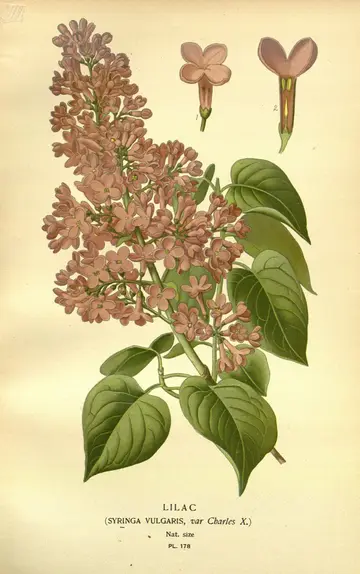
- Common lilac: Its flowers also come in fragrant purple clusters, but the clusters stand upright and are pyramid-shaped, and each small flower is a tube with four lobes. Lilac is a shrub, not a climber, with simple leaves in opposite pairs; wisteria has pinnate leaves, hanging clusters and pea-like flowers.
Side by side
| Chinese wisteria | Common lilac | |
|---|---|---|
| Scientific name | Wisteria sinensis | Syringa vulgaris |
| Family | Fabaceae (legume family) | Oleaceae (olive family) |
| Form | climber, perennial, deciduous | shrub, perennial, deciduous |
| Height | Climbs to 20–30 m | 2–7 m; garden varieties mostly 4–5 m |
| Flower colour | Purple, Blue, White | Purple, White, Pink |
| Origin | China | Balkans |
| Toxicity | People: toxic · Cats: toxic · Dogs: toxic | — |
| Flowering | ||
| Leaves | Odd-pinnate leaves 10–30 cm long with 7–13 oblong, glossy leaflets. | Opposite (sometimes in whorls of three), oval to heart-shaped, pointed, smooth-edged, hairless leaves 4–12 cm long. |
| Flowers | Purple, blue-violet or white pea-like flowers in hanging clusters 15–20 cm long; all the flowers in a cluster open together and smell like grapes. | Small flowers with a 6–10 mm tube and a four-lobed mouth 5–8 mm wide, in dense pyramidal clusters 8–18 cm long at the shoot tips. Usually lilac-purple, sometimes white; very fragrant. |
| Fruit and seeds | Flat, brown, velvety pods 5–10 cm long holding disc-shaped seeds about 1 cm across; they twist open when dry. | A dry, brown, smooth capsule 1–2 cm long that splits in two to release two winged seeds. |
All pairs: look-alike plants · Full pages: Chinese wisteria, Common lilac