Telling them apart
Black locust vs Chinese wisteria
Black locust (Robinia pseudoacacia) and Chinese wisteria (Wisteria sinensis) look similar enough to be confused. Both belong to the same family, Fabaceae (legume family).
CautionBlack locust and Chinese wisteria are poisonous to people. Never pick or eat a wild plant unless you are certain of its identity. If poisoning is suspected, call your local poison centre or emergency number.
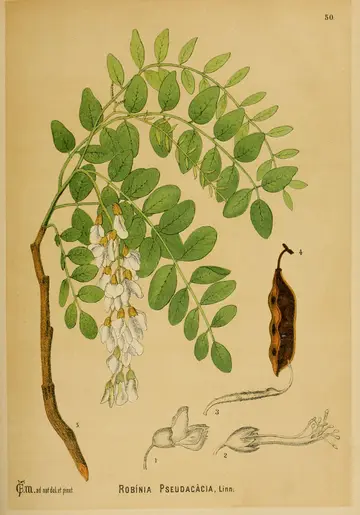
Image wanted. A licensed image will be added when found.
How to tell them apart
- Black locust: Also has hanging clusters of pea-like flowers, but it is a tree and its flowers are white.
Side by side
| Black locust | Chinese wisteria | |
|---|---|---|
| Scientific name | Robinia pseudoacacia | Wisteria sinensis |
| Family | Fabaceae (legume family) | Fabaceae (legume family) |
| Form | tree, perennial, deciduous | climber, perennial, deciduous |
| Height | 12–30 m | Climbs to 20–30 m |
| Flower colour | White | Purple, Blue, White |
| Origin | Eastern United States | China |
| Toxicity | People: toxic | People: toxic · Cats: toxic · Dogs: toxic |
| Flowering | ||
| Leaves | Compound leaves 15–36 cm long with 9–19 oval leaflets. A pair of stiff thorns sits at the base of each leaf. | Odd-pinnate leaves 10–30 cm long with 7–13 oblong, glossy leaflets. |
| Flowers | White, pea-like, very fragrant flowers in hanging clusters; an important nectar source for bees. | Purple, blue-violet or white pea-like flowers in hanging clusters 15–20 cm long; all the flowers in a cluster open together and smell like grapes. |
| Fruit and seeds | Flat, brown pods 5–10 cm long that stay on the tree through winter. | Flat, brown, velvety pods 5–10 cm long holding disc-shaped seeds about 1 cm across; they twist open when dry. |
All pairs: look-alike plants · Full pages: Black locust, Chinese wisteria