Description
Form
herbaceous, perennial
Height: 50–100 cm
Flower colour
PurpleBlue
Flowering
May–August
Habitat
Leaves
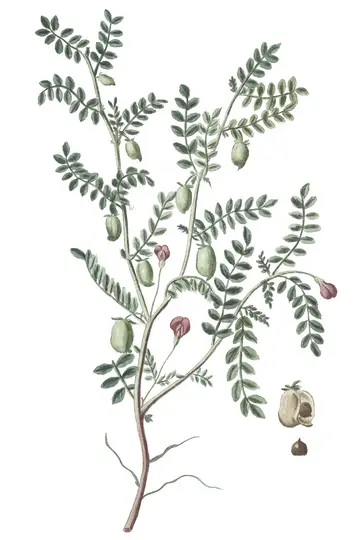
Leaves of three elongated leaflets, toothed at the tip.
Flowers
Clusters of 5–20 small butterfly-shaped flowers, usually purple, sometimes blue, yellow or cream.
Fruit and seeds
Small pods coiled in a spiral, holding small yellowish seeds.
Classification
- KingdomPlantae
- PhylumTracheophyta
- ClassMagnoliopsida
- OrderFabales
- FamilyFabaceae
- GenusMedicago
- SpeciesMedicago sativa
Native range
According to POWO it is native to Türkiye, Iran, Iraq, the Caucasus, the Crimea, Central Asia (Kazakhstan, Kyrgyzstan, Tajikistan, Turkmenistan, Uzbekistan), the north-western Balkans, Italy, France, Algeria and Tunisia.
IUCN Red List status: Least concern (LC).
Growing conditions
Light
Full sun.
Water
Drought tolerant; its deep roots reach groundwater.
Soil
Deep, free-draining, limy or neutral soil.
Temperature
Cold-hardy.
One sowing yields for 4–8 years or more. Bacteria in its roots fix nitrogen from the air.
Culture and history
The name
The name "alfalfa" comes from Arabic by way of Spanish. The linguist Calvert Watkins suggested the Arabic word may come from an old Iranian compound meaning "horse food".
A refuge for insects
Alfalfa fields shelter predatory and parasitic insects that eat crop pests; mowing in strips keeps these insects alive.
Look-alikes
- Clovers (Trifolium species): Also have three-leaflet leaves, but their flowers are in round heads and their pods are not coiled.
- Sickle medick (Medicago falcata): A close relative with yellow flowers and sickle-shaped, not coiled, pods.
Questions
Are alfalfa and lucerne the same plant?
Yes. Alfalfa is the North American name for Medicago sativa; in Britain and Australia it is called lucerne.
Alfalfa: when does it flower?
In spring and summer: May–August. Months are for temperate northern-hemisphere climates and shift with altitude and weather.
Alfalfa: how do you grow it?
Light: Full sun. Water: Drought tolerant; its deep roots reach groundwater. Soil: Deep, free-draining, limy or neutral soil. Temperature: Cold-hardy. One sowing yields for 4–8 years or more. Bacteria in its roots fix nitrogen from the air.
Alfalfa: what is its scientific name?
Medicago sativa L., in the genus Medicago and the family Fabaceae.
Sources
- Wikipedia: Alfalfa
- World Flora Online
- Plants of the World Online (Kew) · native range (WCVP)
- GBIF · classification
- Wikidata
Checked: 2026-11-17. Spotted a mistake? Tell us.