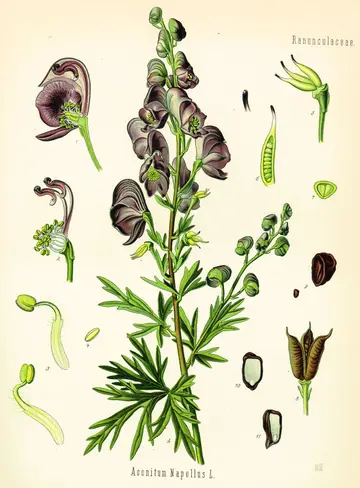
Description
Form
herbaceous (tuberous), perennial
Flower colour
RedWhiteBlue
Flowering
April–June
Leaves
A whorl of small leaves sits on the stem just below the flower.
Flowers
Single flowers 3–8 cm across with five to eight showy, petal-like tepals, red (sometimes white or blue), around a black centre.
Fruit and seeds
Each flower produces 200–300 seeds. Underground it forms hard black tubers.
Classification
- KingdomPlantae
- PhylumTracheophyta
- ClassMagnoliopsida
- OrderRanunculales
- FamilyRanunculaceae
- GenusAnemone
- SpeciesAnemone coronaria
Native range
According to POWO it is native around the Mediterranean, from southern Europe (Spain, France, Italy, the Balkans, Greece) to North Africa, Türkiye, Cyprus, the Levant, Iraq and Iran.
Culture and history
The blood of Adonis
According to Wikipedia in one tale it springs from a deity transformed into a flower stained by the blood of Adonis. The name coronaria ("crowned") refers to the crown at the centre of the flower.
Look-alikes
- Common poppy (Papaver rhoeas): Its red flowers look like an anemone's, but they have four petals and no whorl of leaves below the flower, and the fruit is a smooth, egg-shaped capsule with a lid on top. Compare side by side →
Questions
How do you tell a poppy anemone from a poppy?
The anemone has a whorl of small leaves on the stem just below the flower and five to eight petal-like tepals; the poppy has four petals and no leaf whorl below the flower.
Poppy anemone: when does it flower?
In spring and summer: April–June. Months are for temperate northern-hemisphere climates and shift with altitude and weather.
Poppy anemone: what is its scientific name?
Anemone coronaria L., in the genus Anemone and the family Ranunculaceae.
Sources
- Wikipedia: Anemone coronaria
- World Flora Online
- Plants of the World Online (Kew) · native range (WCVP)
- GBIF · classification
- Wikidata
Checked: 2026-11-22. Spotted a mistake? Tell us.