Description
Form
herbaceous, perennial (grown as an annual)
Height: 0.5–1 m
Flower colour
WhitePinkPurple
Flowering
No reliable data in the sources.
Leaves
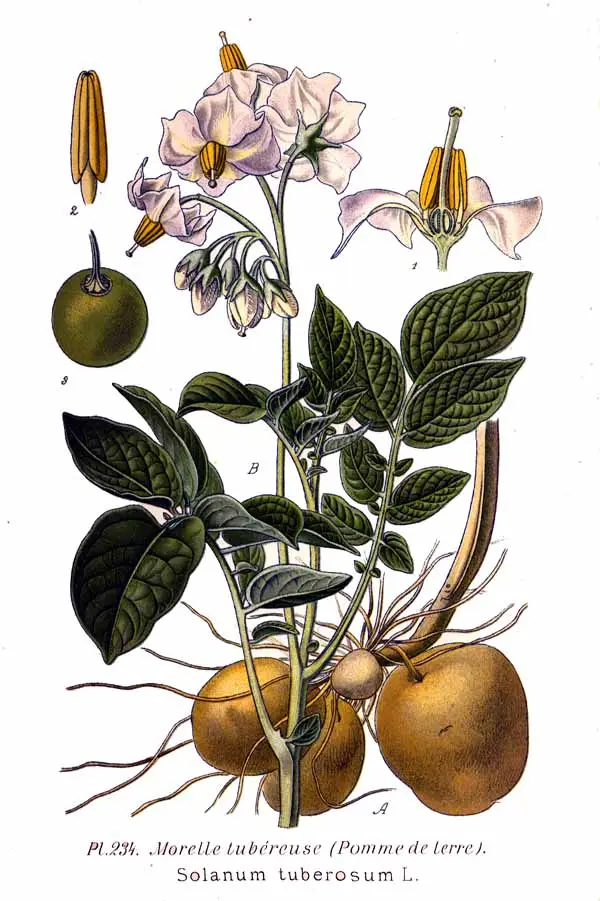
Compound leaves made of alternating large and small leaflets.
Flowers
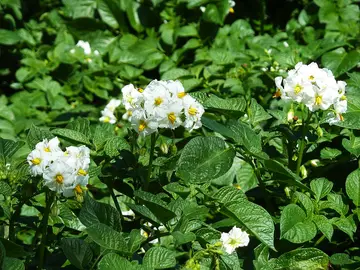
White, pink or purple five-pointed flowers with yellow anthers in the centre.
Fruit and seeds
Some varieties produce small, green, tomato-like berries, which are poisonous. The tuber is botanically not a fruit but the tip of an underground stem (stolon).
Classification
- KingdomPlantae
- PhylumTracheophyta
- ClassMagnoliopsida
- OrderSolanales
- FamilySolanaceae
- GenusSolanum
- SpeciesSolanum tuberosum
Native range
According to POWO it is native along the Andes from Venezuela through Colombia, Ecuador, Peru and Bolivia to Chile and Argentina. It was domesticated in what is now southern Peru and northwestern Bolivia.
Growing conditions
Light
Full sun.
Water
Regular; drought during tuber formation lowers the yield.
Soil
Loose, free-draining, slightly acid soil.
Temperature
Likes a cool climate; not frost hardy.
Grown from tubers (seed potatoes), not seed. Tubers exposed to light turn green; green parts should not be eaten.
Culture and history
The Irish famine
Between 1845 and 1849, potato blight (Phytophthora infestans) destroyed Ireland's potato harvests. Because much of the population depended on potatoes, about a million people died in the Great Famine and as many emigrated.
Toxicity
Potato leaves, stems, berries, sprouts and tubers that have turned green in the light contain glycoalkaloids such as solanine. Green and sprouting parts should be removed before eating.
In an emergency call your local poison centre; for pets, contact a vet straight away. See also: plants and pets.
Look-alikes
- Tomato: Same genus, with yellow flowers. Compare side by side →
Questions
Is a potato a root?
No. The tuber is the swollen tip of an underground stem; its "eyes" are the stem's buds.
Are green potatoes poisonous?
Tubers exposed to light build up solanine along with chlorophyll. Green and sprouting parts should not be eaten.
Potato: how do you grow it?
Light: Full sun. Water: Regular; drought during tuber formation lowers the yield. Soil: Loose, free-draining, slightly acid soil. Temperature: Likes a cool climate; not frost hardy. Grown from tubers (seed potatoes), not seed. Tubers exposed to light turn green; green parts should not be eaten.
Potato: what is its scientific name?
Solanum tuberosum L., in the genus Solanum and the family Solanaceae.
Sources
- Wikipedia: Potato
- World Flora Online
- Plants of the World Online (Kew) · native range (WCVP)
- GBIF · classification
- Wikidata
- Wikipedia: Great Famine (Ireland)
Checked: 2026-11-16. Spotted a mistake? Tell us.