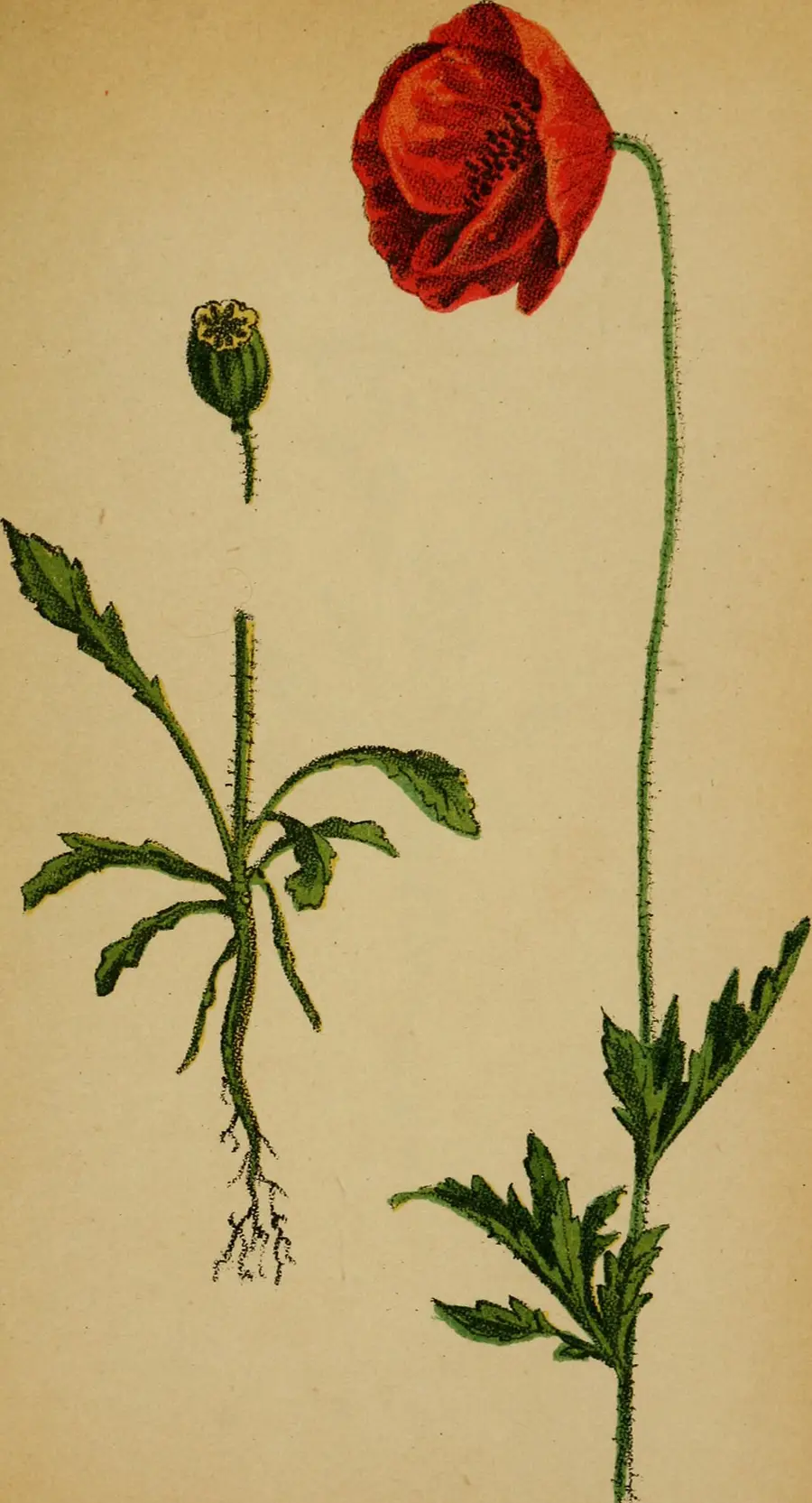

Description
Form
herbaceous, annual
Height: 20–70 cm
Flower colour
Red
Flowering
April–June
Habitat
Leaves
Deeply divided, roughly hairy, toothed leaves.
Flowers
Single flowers 5–10 cm across on long stalks, with four bright red petals, often with a black blotch at the base. The bud hangs down and straightens as it opens.
Fruit and seeds
A hairless, egg-shaped capsule that scatters many tiny seeds through holes under its cap. The seeds can stay alive in the soil for many years.
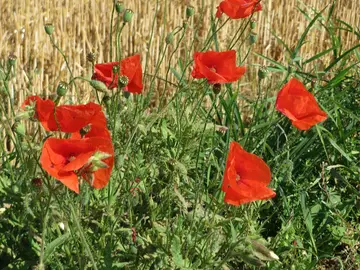

Classification
- KingdomPlantae
- PhylumTracheophyta
- ClassMagnoliopsida
- OrderRanunculales
- FamilyPapaveraceae
- GenusPapaver
- SpeciesPapaver rhoeas
Native range
According to POWO it is native to most of Europe, North Africa, Macaronesia and from Türkiye to Iran, Central Asia and Pakistan. It has spread with agriculture to many parts of the world.
Culture and history
Flower of remembrance
After the First World War the poppy became the symbol of remembrance for the war dead, having bloomed over the scarred ground of Flanders. In Commonwealth countries paper poppies are worn every November.
A plant of cereal fields
Poppies germinate where soil is ploughed, so they have accompanied cereal fields since the earliest days of farming. With herbicides they have declined in fields in many countries.
Look-alikes
- Opium poppy (Papaver somniferum): Its leaves are bluish green, hairless and clasp the stem, and its capsule is much larger. Growing it in Türkiye requires a permit.
- Horned poppies (Glaucium): Yellow or orange flowers and long, horn-shaped fruits.
Questions
Why do poppies wilt so quickly?
Their petals are very thin and lose water fast once picked, so they do not last in a vase.
Common poppy: when does it flower?
In spring and summer: April–June. Months are for temperate northern-hemisphere climates and shift with altitude and weather.
Common poppy: what is its scientific name?
Papaver rhoeas L., in the genus Papaver and the family Papaveraceae.
Sources
- Wikipedia: Papaver rhoeas
- World Flora Online
- Plants of the World Online (Kew) · native range (WCVP)
- GBIF · classification
- Wikidata
Checked: 2026-11-16. Spotted a mistake? Tell us.