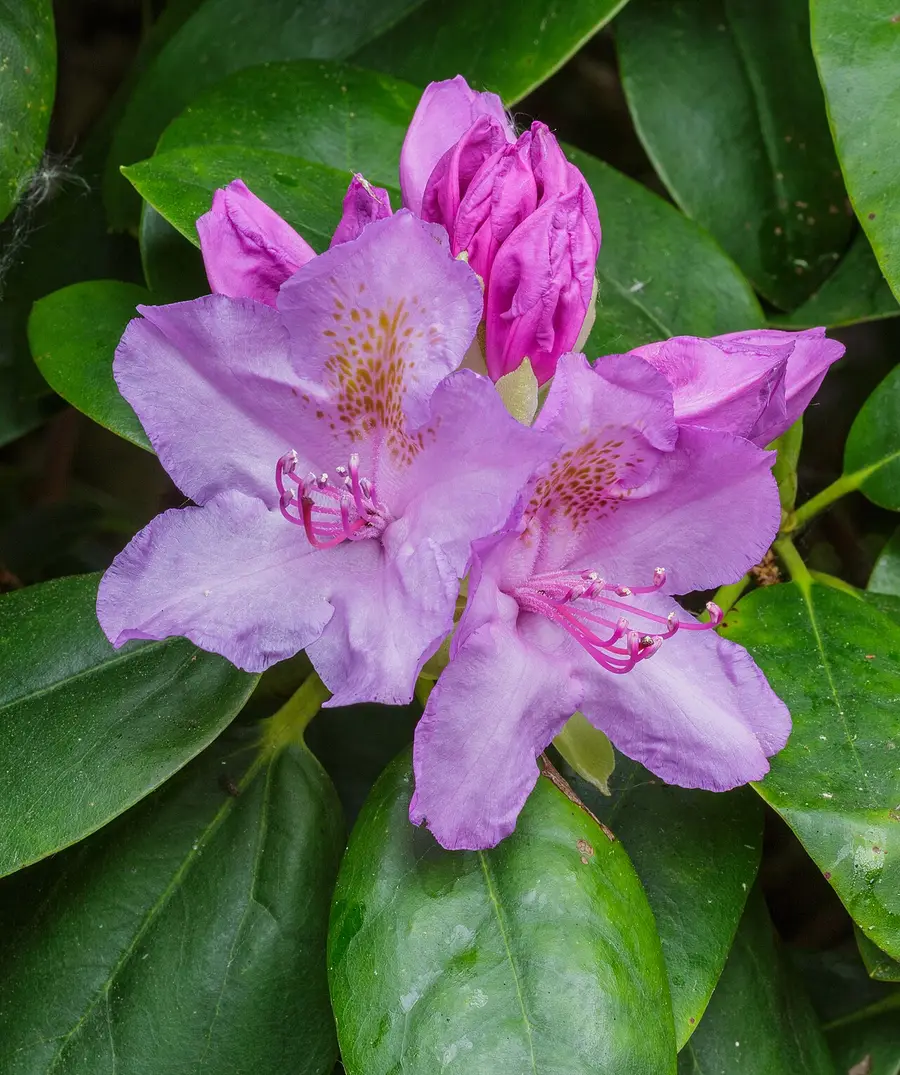

Description
Form
shrub, perennial, evergreen
Height: 2–5 m
Flower colour
PurplePink
Flowering
April–June
Habitat
Leaves
Large, leathery, glossy dark green, lance-shaped leaves.
Flowers
Large clusters of broad, funnel-shaped purple or lilac flowers at the branch tips; the upper petal is spotted yellowish brown.
Fruit and seeds
A dry, woody capsule.
Classification
- KingdomPlantae
- PhylumTracheophyta
- ClassMagnoliopsida
- OrderEricales
- FamilyEricaceae
- GenusRhododendron
- SpeciesRhododendron ponticum
Native range
According to POWO it is native to Türkiye, the Caucasus, Bulgaria and Lebanon–Syria, with a separate population in Spain and Portugal. Planted as an ornamental in Britain and Ireland, it has spread to become invasive.
Culture and history
Mad honey
In the eastern Black Sea region, honey made from rhododendron nectar contains grayanotoxins and is known as "mad honey" (deli bal). The Greek writer Xenophon tells how Greek soldiers who ate such honey near Trebizond in 401 BC were poisoned.
Toxicity
All parts of the plant, and its nectar, contain grayanotoxins. ASPCA lists signs in pets as vomiting, diarrhoea, drooling, weakness, low blood pressure, central nervous system depression, cardiovascular collapse and death. In people, poisoning usually comes from "mad honey". Goats and sheep have been poisoned by eating the leaves.
In an emergency call your local poison centre; for pets, contact a vet straight away. See also: plants and pets.
Look-alikes
- Yellow azalea (Rhododendron luteum): A deciduous relative with fragrant yellow flowers, native in the Black Sea region; it also contains grayanotoxins.
Questions
What is mad honey?
Honey made from the nectar of certain rhododendrons in the eastern Black Sea region; it contains grayanotoxins and can cause poisoning.
Pontic rhododendron: when does it flower?
In spring and summer: April–June. Months are for temperate northern-hemisphere climates and shift with altitude and weather.
Pontic rhododendron: is it toxic to cats and dogs?
Toxic to cats and dogs and people. Grayanotoxins; "mad honey" poisoning.
Pontic rhododendron: what is its scientific name?
Rhododendron ponticum L., in the genus Rhododendron and the family Ericaceae.
Sources
- Wikipedia: Rhododendron ponticum
- World Flora Online
- Plants of the World Online (Kew) · native range (WCVP)
- GBIF · classification
- Wikidata
- ASPCA Animal Poison Control: Rhododendron (Azalea)
- Wikipedia: Grayanotoxin / Mad honey
Checked: 2026-11-16. Spotted a mistake? Tell us.