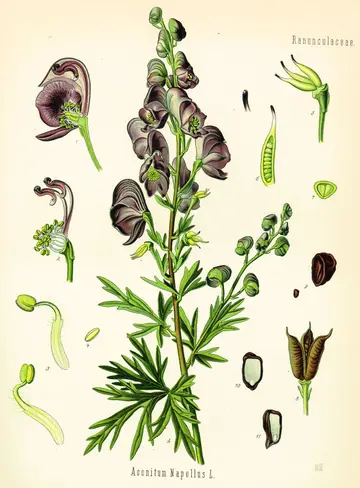
Description
Form
herbaceous, annual
Height: 20–40 cm
Flower colour
BlueWhite
Flowering
May–July
Habitat
Leaves
Thread-like, finely divided, light green leaves.
Flowers
Five pale blue or white petal-like sepals around a greenish centre.
Fruit and seeds
A swollen capsule of fused sections with horn-like tips, containing many angular black seeds.
Classification
- KingdomPlantae
- PhylumTracheophyta
- ClassMagnoliopsida
- OrderRanunculales
- FamilyRanunculaceae
- GenusNigella
- SpeciesNigella sativa
Native range
According to POWO it is native to Türkiye (Anatolia), Cyprus, Lebanon-Syria, Iraq, Iran, the Caucasus, Turkmenistan, Bulgaria and Romania.
Culture and history
In the pharaoh's tomb
Black cumin seeds were found in Tutankhamun's tomb.
Health claims
Many health claims circulate about this plant; the Plants Atlas gives no health advice, and a doctor should be consulted before using it.
Look-alikes
- Love-in-a-mist (Nigella damascena): A garden relative whose flowers are surrounded by a "veil" of finely divided leaves; its capsules are balloon-like.
- Cumin: Not related despite the name; cumin is in the carrot family and its fruits are long, ribbed and light brown. Compare side by side →
Questions
Are black cumin and cumin related?
No. Black cumin is in the buttercup family and cumin in the carrot family; the name is misleading.
Black cumin: when does it flower?
In spring and summer: May–July. Months are for temperate northern-hemisphere climates and shift with altitude and weather.
Black cumin: what is its scientific name?
Nigella sativa L., in the genus Nigella and the family Ranunculaceae.
Sources
- Wikipedia: Nigella sativa
- World Flora Online
- Plants of the World Online (Kew) · native range (WCVP)
- GBIF · classification
- Wikidata
Checked: 2026-11-17. Spotted a mistake? Tell us.