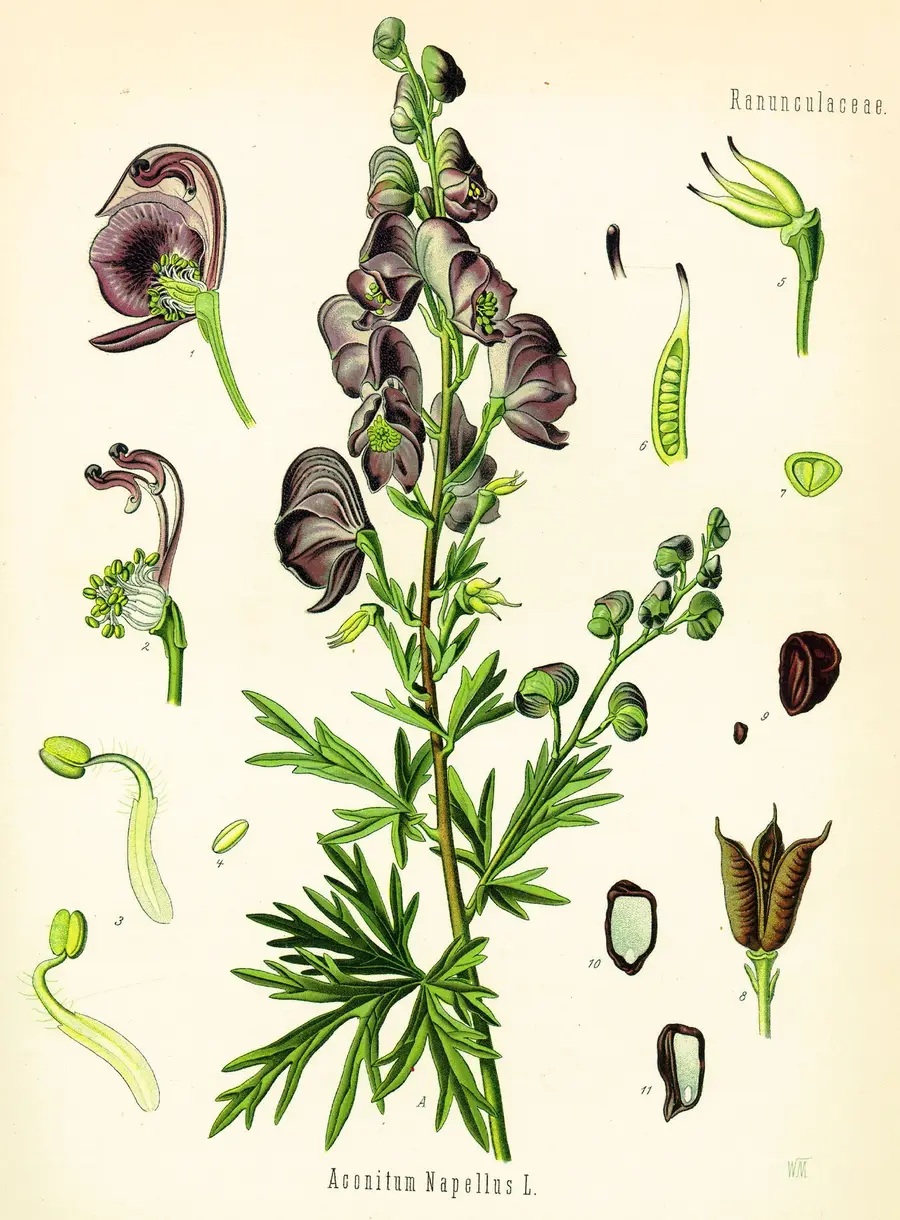

Description
Form
herb, perennial
Height: 0.5–1.5 m
Flower colour
BluePurple
Flowering
June–August
Habitat
Leaves
Deeply divided, hand-shaped leaves.
Flowers
Deep blue-purple flowers in an upright spike, the upper petal closed over like a helmet or a monk's hood.
Fruit and seeds
A three-part dry fruit (follicles).
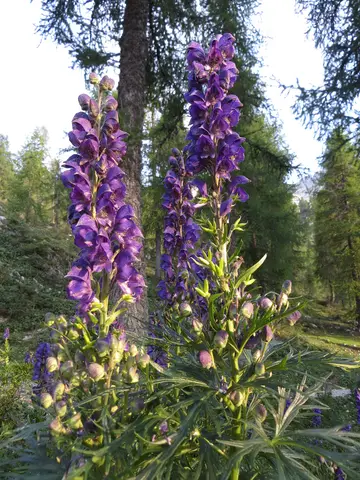

Classification
- KingdomPlantae
- PhylumTracheophyta
- ClassMagnoliopsida
- OrderRanunculales
- FamilyRanunculaceae
- GenusAconitum
- SpeciesAconitum napellus
Native range
According to POWO it is native to Spain, Portugal, France, Belgium, Germany, Switzerland, Austria, Italy, Czechia-Slovakia and the western Balkans, in damp mountain meadows.
IUCN Red List status: Least concern (LC).
Culture and history
The name
Its English name "wolfsbane" (and its Turkish name, "wolf-strangler") comes from its former use to poison wolves and other predators.
Toxicity
All parts, especially the roots, contain aconitine, which affects the heart and nervous system: tingling and numbness of the mouth, vomiting, heart rhythm disturbances and death. Even handling it bare-handed for long periods can cause poisoning; wear gloves in the garden.
In an emergency call your local poison centre; for pets, contact a vet straight away. See also: plants and pets.
Look-alikes
- Larkspur and delphinium: Have similar blue flower spikes, but each flower has a long spur at the back instead of a helmet. They are poisonous too.
Questions
Is monkshood dangerous to touch?
It is one of Europe's most poisonous plants; aconitine can be absorbed through the skin, so it should be handled only with gloves.
What is aconitine?
The poison found in all parts of monkshood, especially the roots. It affects the heart and nervous system, causing tingling and numbness of the mouth, vomiting, heart rhythm disturbances and death. It can be absorbed through the skin, so the plant should be handled with gloves.
Monkshood: when does it flower?
In summer: June–August. Months are for temperate northern-hemisphere climates and shift with altitude and weather.
Monkshood: is it toxic to cats and dogs?
Toxic to cats and dogs and people. Aconitine; extremely toxic, even through skin.
Monkshood: what is its scientific name?
Aconitum napellus L., in the genus Aconitum and the family Ranunculaceae.
Sources
- Wikipedia: Aconitum napellus
- World Flora Online
- Plants of the World Online (Kew) · native range (WCVP)
- GBIF · classification
- Wikidata
Checked: 2026-11-16. Spotted a mistake? Tell us.