Description
Form
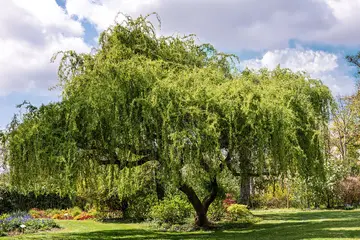
tree, perennial, deciduous
Height: 9–25 m
Flower colour
GreenYellow
Flowering
March–April
Leaves
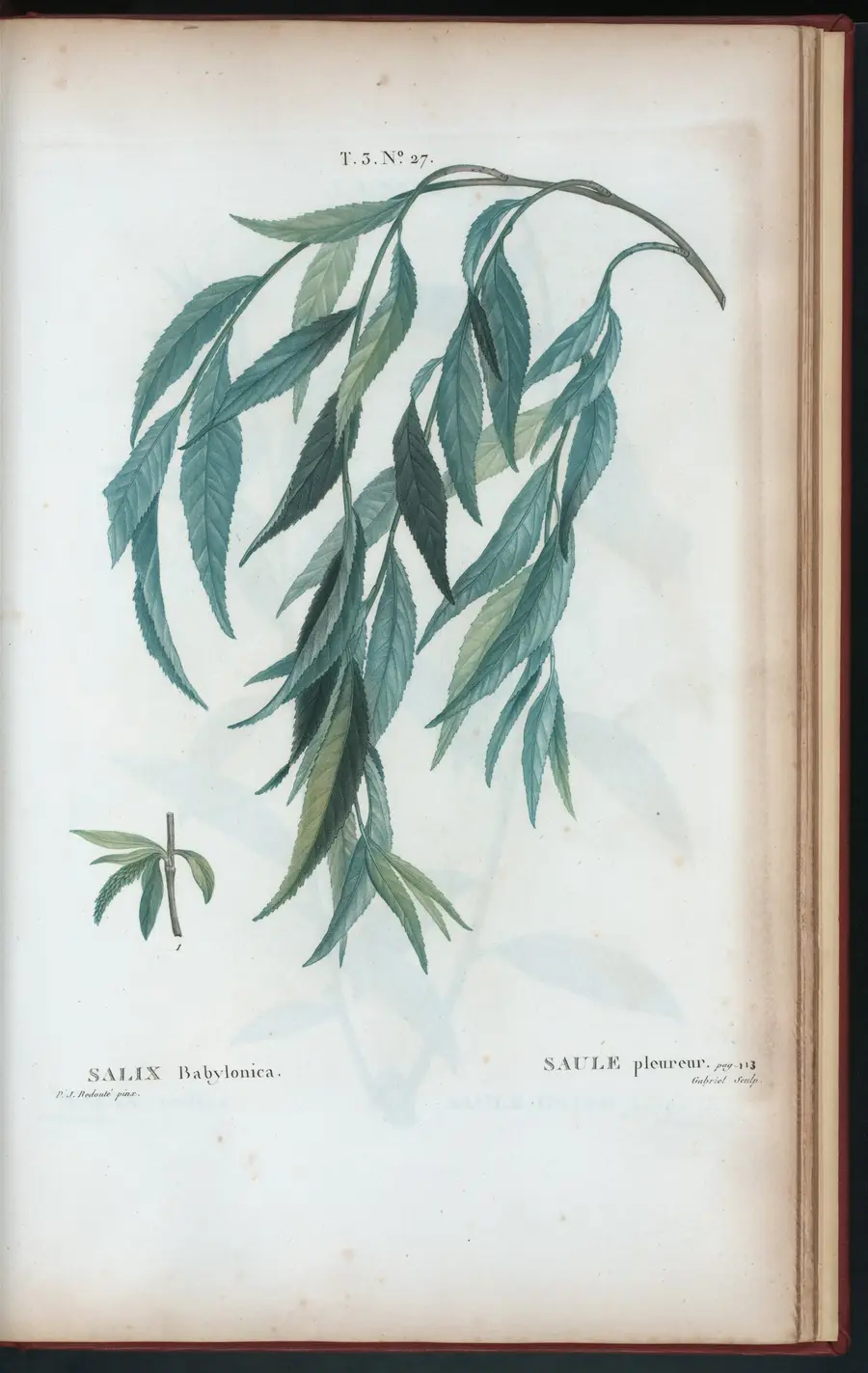
Narrow, lance-shaped leaves 4–16 cm long with long-pointed tips, finely toothed and bluish green underneath; golden yellow in autumn.
Flowers
Small yellowish-green catkins in early spring, male and female on separate trees.
Fruit and seeds
Small capsules releasing cottony seeds.
Classification
- KingdomPlantae
- PhylumTracheophyta
- ClassMagnoliopsida
- OrderMalpighiales
- FamilySalicaceae
- GenusSalix
- SpeciesSalix babylonica
Native range
According to POWO it is native to northern and southeastern China, Inner Mongolia, Manchuria, Korea and Qinghai. Because it has been planted for so long, its true wild range is uncertain: the Flora of China treats it as wild only in Yunnan. It has been grown for centuries along the Silk Road and in temperate regions worldwide.
IUCN Red List status: Data deficient (DD).
Culture and history
The name
Linnaeus named it "babylonica" after the willows by the rivers of Babylon in Psalm 137. But the trees in that text were not willows: they were Euphrates poplars (Populus euphratica), of the same family. The weeping willow itself comes from China.
Why "data deficient"?
The IUCN Red List rates the weeping willow as Data Deficient (DD). The tree is planted all over the world, but very few collections come from truly wild populations. Whether any wild population survives at all is debated.
Look-alikes
- Golden weeping willow (Salix × sepulcralis): Most weeping willows in gardens are hybrids of this species with the white willow (Salix alba).
Questions
Is the weeping willow from Babylon?
No. It comes from China; the name refers to a Biblical psalm, not to its origin.
Weeping willow: when does it flower?
In spring: March–April. Months are for temperate northern-hemisphere climates and shift with altitude and weather.
Weeping willow: what is its scientific name?
Salix babylonica L., in the genus Salix and the family Salicaceae.
Sources
- Wikipedia: Salix babylonica
- World Flora Online
- Plants of the World Online (Kew) · native range (WCVP)
- GBIF · classification
- Wikidata
Checked: 2026-11-16. Spotted a mistake? Tell us.