Description
Form
tree, perennial, deciduous
Height: 15–30 m, rarely more
Flower colour
RedGreen
Flowering
March–April
Leaves
Leaves 4–15 cm long, usually five-lobed or wavy-edged, with a thick covering of white, scurfy down on both sides, thicker underneath.
Flowers
Male and female flowers are on separate trees and open in early spring. Male catkins are grey with conspicuous dark red stamens; female catkins are greyish-green.
Fruit and seeds
After pollination the female catkins lengthen to 8–10 cm and carry green seed capsules that ripen in late spring to early summer.
Classification
- KingdomPlantae
- PhylumTracheophyta
- ClassMagnoliopsida
- OrderMalpighiales
- FamilySalicaceae
- GenusPopulus
- SpeciesPopulus alba
Native range
According to POWO it is native from North Africa (Morocco, Algeria, Tunisia, Libya) through southern and central Europe, Türkiye, the Caucasus, Iran and Afghanistan to Central Asia, the western Himalaya and Xinjiang.
IUCN Red List status: Least concern (LC).
Growing conditions
Light
Plenty of light.
Water
Ample moisture; it stands up well to flooding.
Soil
Tolerates slightly acidic soils and salt.
Its root suckers can cause problems in some places. Because of its extensive roots and salt tolerance it is also planted to stabilise coastal sand dunes.
Culture and history
The panel behind the Mona Lisa
According to Wikipedia its soft, close-grained wood, which shrinks very little as it dries, was the most common support for panel paintings in Italy through the Middle Ages and Renaissance; the Mona Lisa is painted on poplar.
Grey poplar
White poplar hybridises with the aspen (Populus tremula). The hybrid, grey poplar (Populus × canescens), can grow larger than either parent, reaching 40 m.
Look-alikes
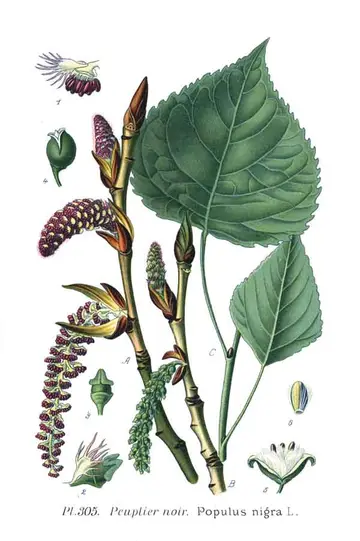
- Black poplar (Populus nigra): Same genus. Black poplar leaves are triangular or diamond-shaped with toothed edges, and their flattened stalks make them tremble in the lightest breeze; white poplar leaves are five-lobed or wavy-edged with bright white, downy undersides. Compare side by side →
Questions
How do you tell white poplar from black poplar?
By the leaves: white poplar leaves are usually five-lobed with a thick white down underneath, while black poplar leaves are triangular or diamond-shaped with toothed edges and flattened stalks that make them tremble.
White poplar: when does it flower?
In spring: March–April. Months are for temperate northern-hemisphere climates and shift with altitude and weather.
White poplar: how do you grow it?
Light: Plenty of light. Water: Ample moisture; it stands up well to flooding. Soil: Tolerates slightly acidic soils and salt. Its root suckers can cause problems in some places. Because of its extensive roots and salt tolerance it is also planted to stabilise coastal sand dunes.
White poplar: what is its scientific name?
Populus alba L., in the genus Populus and the family Salicaceae.
Sources
- Wikipedia: Populus alba
- Plants of the World Online (Kew) · native range (WCVP)
- GBIF · classification
- Wikidata
Checked: 2026-11-23. Spotted a mistake? Tell us.