Description
Form
tree, perennial, deciduous
Height: 20–30 m
Flower colour
RedGreen
Flowering
March–April
Leaves
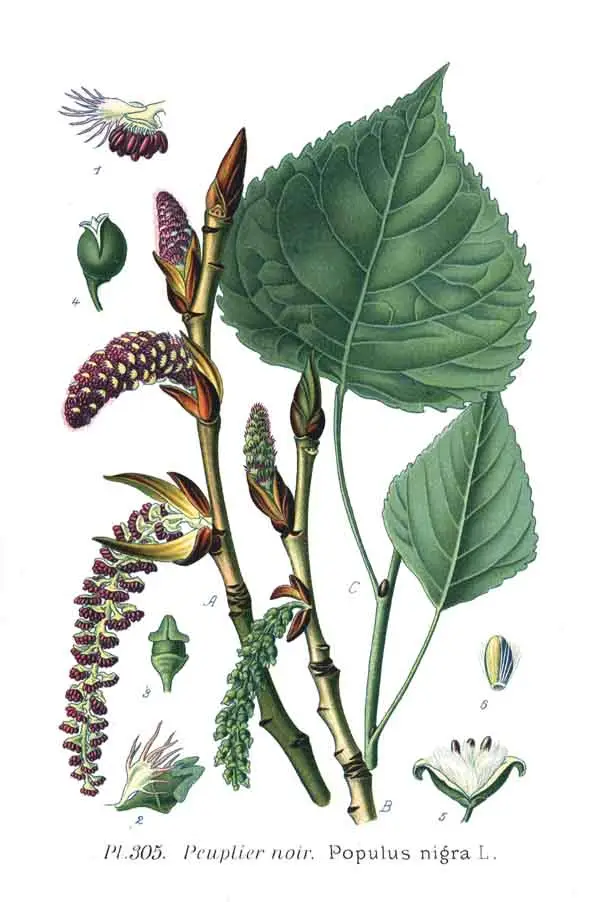
Triangular or diamond-shaped, toothed leaves 5–8 cm long on long stalks. Because the stalk is flattened, the leaves tremble in the slightest breeze.
Flowers
Male and female flowers on separate trees. Male catkins are reddish, female ones greenish; they open before the leaves.
Fruit and seeds
Small capsules that release masses of cottony, hairy seeds when ripe. This "poplar cotton" comes only from female trees.
Classification
- KingdomPlantae
- PhylumTracheophyta
- ClassMagnoliopsida
- OrderMalpighiales
- FamilySalicaceae
- GenusPopulus
- SpeciesPopulus nigra
Native range
According to POWO it is native to most of Europe, North Africa (Morocco, Algeria, Libya), Türkiye, the Caucasus, Central Asia (Kazakhstan) and east to Afghanistan–Pakistan. The Lombardy poplar spread through the Balkans and south-western Asia in the Ottoman period.
IUCN Red List status: Data deficient (DD).
Culture and history
Lombardy poplar
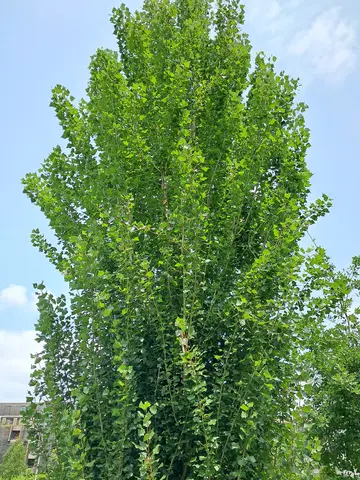
The 'Italica' variety is a candle-shaped male tree whose branches grow upright parallel to the trunk; it is propagated by cuttings. It spread across Europe from Italy's Lombardy region in the 18th century, hence its name.
Poplar cotton
The "poplar cotton" floating in the air in May–June is the fluff that carries the seeds. It is often blamed for allergies, but the fluff is not pollen; the real culprits are grass pollens released at the same time.
Look-alikes
- Hybrid poplars (Populus × canadensis): The poplars most planted for timber in Türkiye; hybrids of black poplar and the American cottonwood.
- White poplar (Populus alba): The undersides of its leaves and its young bark are bright white. Compare side by side →
Questions
Does poplar fluff cause allergies?
Poplar fluff is not pollen but the hairs that carry the seeds. Grass pollen in the air at the same time is the real cause of allergies, though the fluff can still irritate the eyes and nose mechanically.
Black poplar: when does it flower?
In spring: March–April. Months are for temperate northern-hemisphere climates and shift with altitude and weather.
Black poplar: what is its scientific name?
Populus nigra L., in the genus Populus and the family Salicaceae.
Sources
- Wikipedia: Populus nigra
- World Flora Online
- Plants of the World Online (Kew) · native range (WCVP)
- GBIF · classification
- Wikidata
Checked: 2026-11-17. Spotted a mistake? Tell us.