Description
Form
tree, perennial, deciduous
Height: 10–30 m
Flower colour
YellowGreen
Flowering
March–April
Habitat
Leaves
Narrow, lance-shaped leaves 5–10 cm long and 0.5–1.5 cm wide, covered with silky white hairs, especially beneath.
Flowers
Catkins 3–5 cm long in early spring, male and female on separate trees; insect-pollinated.
Fruit and seeds
Small 4 mm capsules on female catkins, releasing tiny seeds wrapped in cottony hairs in midsummer.
Classification
- KingdomPlantae
- PhylumTracheophyta
- ClassMagnoliopsida
- OrderMalpighiales
- FamilySalicaceae
- GenusSalix
- SpeciesSalix alba
Native range
According to POWO it is native to most of Europe, North Africa, Türkiye, the Caucasus, the Middle East, Iran and from Central Asia to western China and Tibet.
IUCN Red List status: Least concern (LC).
Growing conditions
Light
Full sun.
Water
Plenty; likes moist soil.
Soil
Moist, deep soil.
Temperature
Hardy.
Roots very easily from cuttings; plant it away from buildings, as its roots can damage pipes and foundations.
Culture and history
The name
The names white willow and Latin alba come from the white hairs on the leaf undersides. Salicin in willow bark is the compound that led to the development of aspirin.
Look-alikes
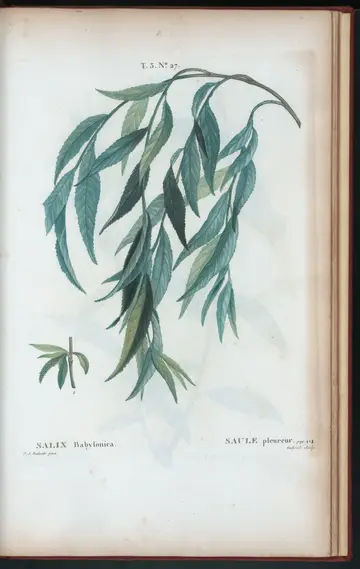
- Weeping willow: Its branches hang down to the ground; its leaves are not as white-hairy. Compare side by side →
- Crack willow (Salix fragilis): Its leaves are broader, glossy and hairless, and its twigs snap off easily at the base.
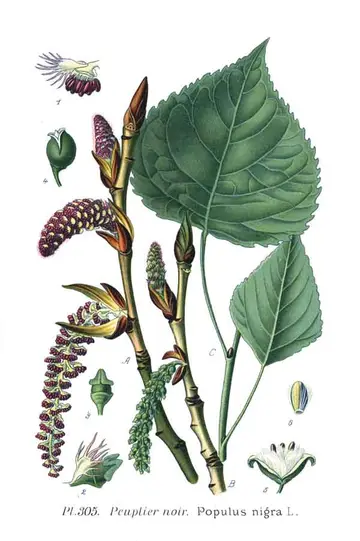
- Black poplar (Populus nigra): Also a waterside tree whose seeds drift on cottony hairs, but its leaves are triangular to diamond-shaped on long, flattened stalks that make them tremble in the slightest breeze. White willow leaves are narrow and lance-shaped, silky white underneath. Compare side by side →
Questions
Why does white willow look silvery?
Its leaves, especially their undersides, are covered with fine silky white hairs that show when the wind turns them over.
White willow: when does it flower?
In spring: March–April. Months are for temperate northern-hemisphere climates and shift with altitude and weather.
White willow: how do you grow it?
Light: Full sun. Water: Plenty; likes moist soil. Soil: Moist, deep soil. Temperature: Hardy.
White willow: how do you propagate it?
Roots very easily from cuttings; plant it away from buildings, as its roots can damage pipes and foundations.
White willow: what is its scientific name?
Salix alba L., in the genus Salix and the family Salicaceae.
Sources
- Wikipedia: Salix alba
- World Flora Online
- Plants of the World Online (Kew) · native range (WCVP)
- GBIF · classification
- Wikidata
Checked: 2026-11-17. Spotted a mistake? Tell us.