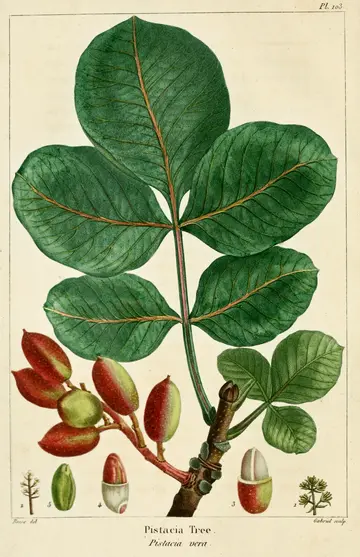
Description
Form
shrub or small tree, perennial, deciduous
Height: 2–10 m
Flower colour
RedPurple
Flowering
March–April
Habitat
Leaves
Odd-pinnate leaves 10–20 cm long with 5–11 glossy, oval leaflets, smelling of resin.
Flowers
Clusters of small, reddish-purple flowers in spring, with the leaves; male and female plants are separate.
Fruit and seeds
Small, round fruits 5–7 mm across, red at first and greenish-blue or black when ripe.
Classification
- KingdomPlantae
- PhylumTracheophyta
- ClassMagnoliopsida
- OrderSapindales
- FamilyAnacardiaceae
- GenusPistacia
- SpeciesPistacia terebinthus
Native range
According to POWO it is native around the Mediterranean, from Portugal and Morocco to Spain, France, Italy, the Mediterranean islands, the Balkans, Greece, Cyprus and Türkiye, the Levant and North Africa.
IUCN Red List status: Least concern (LC).
Culture and history
Turpentine
The resin from its trunk was historically known as "turpentine"; today turpentine comes mostly from pines.
Look-alikes
- Mastic tree: Same genus, but evergreen and without a single end leaflet. Compare side by side →
- Pistachio: Same genus; fewer, much larger leaflets and a large, edible nut. Compare side by side →
Questions
Are terebinth and pistachio related?
Yes, both are Pistacia. In Türkiye terebinth is also used as a rootstock for grafting pistachio.
Terebinth: when does it flower?
In spring: March–April. Months are for temperate northern-hemisphere climates and shift with altitude and weather.
Terebinth: what is its scientific name?
Pistacia terebinthus L., in the genus Pistacia and the family Anacardiaceae.
Sources
- Wikipedia: Pistacia terebinthus
- World Flora Online
- Plants of the World Online (Kew) · native range (WCVP)
- GBIF · classification
- Wikidata
Checked: 2026-11-17. Spotted a mistake? Tell us.