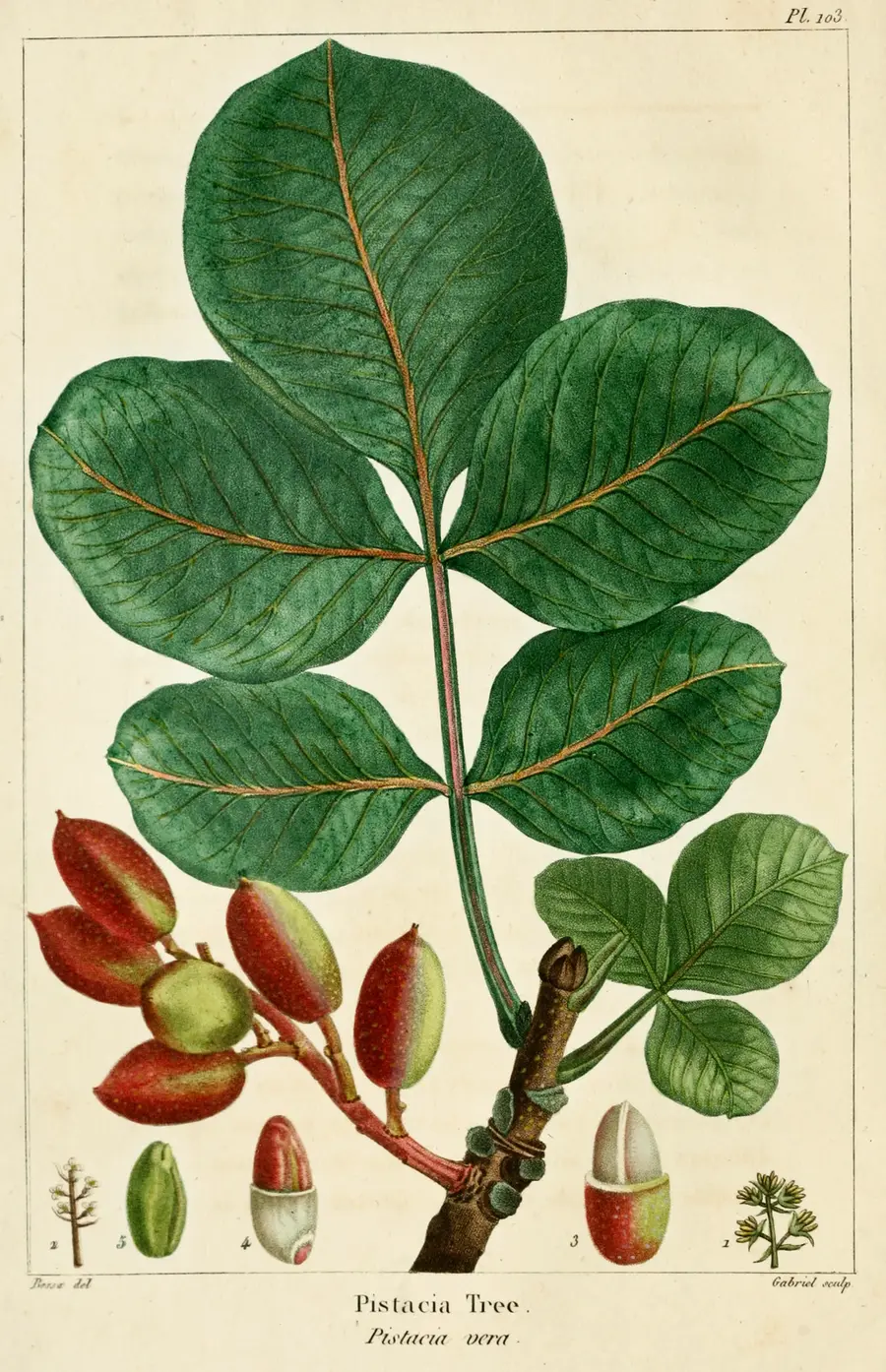

Description
Form
tree, perennial, deciduous
Height: 5–10 m
Flower colour
RedGreen
Flowering
April
Leaves
Compound leaves of 3–5 thick, leathery leaflets.
Flowers
Small flowers without petals in clusters; male and female flowers on separate trees, pollinated by wind.
Fruit and seeds
A hard-shelled nut inside a reddish outer husk; the shell often splits open by itself when ripe.
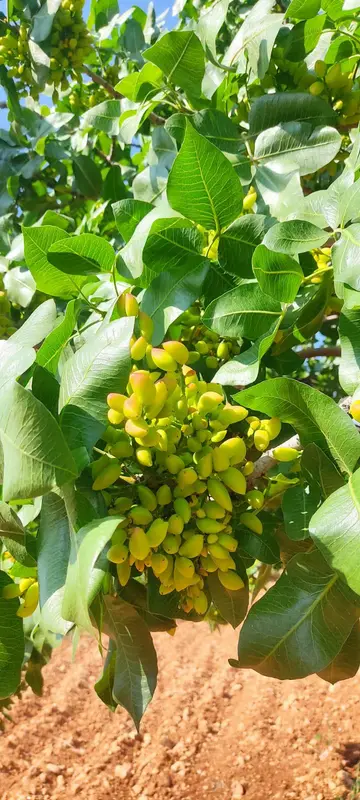

Classification
- KingdomPlantae
- PhylumTracheophyta
- ClassMagnoliopsida
- OrderSapindales
- FamilyAnacardiaceae
- GenusPistacia
- SpeciesPistacia vera
Native range
According to POWO it is native to Iran, Afghanistan, Turkmenistan, Uzbekistan, Tajikistan, Kyrgyzstan and Kazakhstan. It reached the Mediterranean in ancient times.
IUCN Red List status: Near threatened (NT).
Growing conditions
Light
Full sun.
Water
Very drought tolerant.
Soil
Grows even in limy, stony, poor soil; dislikes wet ground.
Temperature
Needs long, hot, dry summers and some winter chill.
Female trees need a male tree nearby to bear nuts. Trees crop heavily one year and lightly the next.
Culture and history
Baklava
The green filling of Gaziantep baklava comes from pistachios harvested early, before they are ripe.
Toxicity
Pistachios can cause severe allergic reactions in people with tree-nut allergies. Nuts stored in damp conditions can develop mould toxins (aflatoxins).
In an emergency call your local poison centre; for pets, contact a vet straight away. See also: plants and pets.
Look-alikes
- Terebinth (Pistacia terebinthus): A wild relative native to Türkiye with very small fruit, also used as a rootstock for pistachio. Compare side by side →
Questions
Is the pistachio native to Türkiye?
No. It comes from Iran and Central Asia, but it has long been grown in southeastern Türkiye, especially around Gaziantep.
Pistachio: when does it flower?
In spring: April. Months are for temperate northern-hemisphere climates and shift with altitude and weather.
Pistachio: how do you grow it?
Light: Full sun. Water: Very drought tolerant. Soil: Grows even in limy, stony, poor soil; dislikes wet ground. Temperature: Needs long, hot, dry summers and some winter chill. Female trees need a male tree nearby to bear nuts. Trees crop heavily one year and lightly the next.
Pistachio: what is its scientific name?
Pistacia vera L., in the genus Pistacia and the family Anacardiaceae.
Sources
- Wikipedia: Pistachio
- World Flora Online
- Plants of the World Online (Kew) · native range (WCVP)
- GBIF · classification
- Wikidata
Checked: 2026-11-16. Spotted a mistake? Tell us.