Description
Form
tree, perennial, evergreen
Height: 15–30 m
Flower colour
WhitePink
Flowering
January–March
Habitat
Leaves
Long, lance-shaped, leathery, glossy leaves; copper-red or purplish on young shoots.
Flowers
Large, upright clusters at the branch tips, made of hundreds of small, whitish-pink flowers.
Fruit and seeds
A juicy drupe with yellow, orange or reddish skin and a large, flat stone.
Classification
- KingdomPlantae
- PhylumTracheophyta
- ClassMagnoliopsida
- OrderSapindales
- FamilyAnacardiaceae
- GenusMangifera
- SpeciesMangifera indica
Native range
According to POWO it is native to north-eastern India (Assam), the eastern Himalaya, Myanmar, Thailand and south-central China. It is grown throughout the tropics.
IUCN Red List status: Data deficient (DD).
Culture and history
A national symbol
The mango is the national fruit of India, Pakistan and the Philippines, and the mango tree is the national tree of Bangladesh.
Toxicity
The mango is in the same family as poison ivy. Its skin, leaves and sap contain compounds similar to urushiol and can cause an itchy skin rash on contact in some people.
In an emergency call your local poison centre; for pets, contact a vet straight away. See also: plants and pets.
Look-alikes
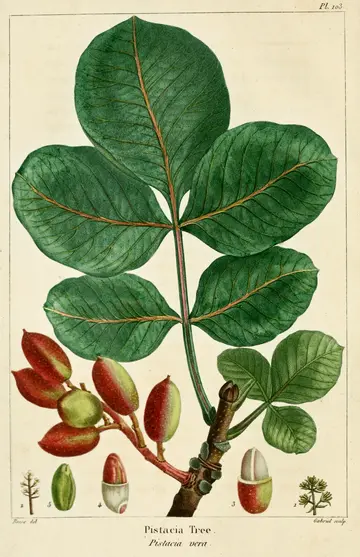
- Pistachio: Same family (Anacardiaceae), but a deciduous tree with small leaves. Compare side by side →
Questions
Which family does the mango belong to?
The mango is in the same family as the pistachio, mastic tree and cashew (Anacardiaceae, the cashew family).
Can mango skin cause a rash?
In some people, yes. The skin and sap contain urushiol-like compounds, like those of its relative poison ivy, and can cause an itchy rash on contact.
Mango: when does it flower?
In winter and spring: January–March. Months are for temperate northern-hemisphere climates and shift with altitude and weather.
Mango: what is its scientific name?
Mangifera indica L., in the genus Mangifera and the family Anacardiaceae.
Sources
- Wikipedia: Mangifera indica
- World Flora Online
- Plants of the World Online (Kew) · native range (WCVP)
- GBIF · classification
Checked: 2026-11-17. Spotted a mistake? Tell us.