Description
Form
shrub or small tree, perennial, evergreen
Height: 1–5 m
Flower colour
Red
Flowering
March–May
Leaves
Evenly pinnate leaves (no single end leaflet) with 4–10 leathery, glossy leaflets and a winged stalk. They smell of resin when crushed.
Flowers
Small, reddish flower clusters in the leaf axils; male and female plants are separate.
Fruit and seeds
Small, round, one-seeded fruits, red at first and then black.
Classification
- KingdomPlantae
- PhylumTracheophyta
- ClassMagnoliopsida
- OrderSapindales
- FamilyAnacardiaceae
- GenusPistacia
- SpeciesPistacia lentiscus
Native range
According to POWO it is native almost throughout the Mediterranean basin (Spain, Portugal, France, Italy, the Balkans, Greece, Türkiye, Cyprus, the Levant and North Africa) and the Canary Islands.
IUCN Red List status: Least concern (LC).
Growing conditions
Light
Full sun.
Water
Very drought tolerant.
Soil
Not fussy; grows on rocky and limy soils.
Temperature
Not hardy to hard frost.
Slow-growing; takes pruning well.
Culture and history
Mastic
Resin from the mastic trees of southern Chios (Pistacia lentiscus var. chia) has been collected for thousands of years. The know-how of cultivating mastic on the island was added to UNESCO's list of the Intangible Cultural Heritage of Humanity in 2014.
Look-alikes
- Terebinth (Pistacia terebinthus): Same genus and the same habitats, but deciduous, with oddly pinnate leaves (a single leaflet at the tip). Compare side by side →
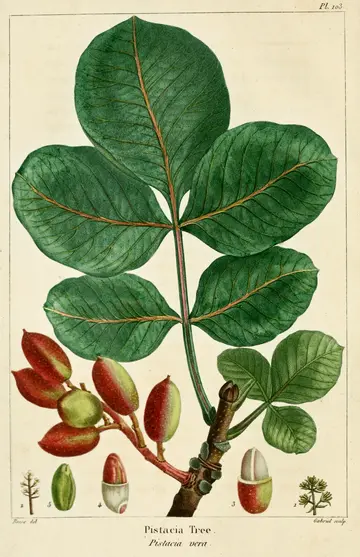
- Pistachio: Same genus; deciduous, with fewer, larger leaflets. Compare side by side →
Questions
Which tree does mastic come from?
From the resin that oozes when the bark of the mastic tree (Pistacia lentiscus) is scored. Traditional mastic comes from the trees of Chios; mastic trees have also been planted around Çeşme.
Mastic tree: when does it flower?
In spring: March–May. Months are for temperate northern-hemisphere climates and shift with altitude and weather.
Mastic tree: how do you grow it?
Light: Full sun. Water: Very drought tolerant. Soil: Not fussy; grows on rocky and limy soils. Temperature: Not hardy to hard frost.
Mastic tree: when and how do you prune it?
Slow-growing; takes pruning well.
Mastic tree: what is its scientific name?
Pistacia lentiscus L., in the genus Pistacia and the family Anacardiaceae.
Sources
- Wikipedia: Pistacia lentiscus
- World Flora Online
- Plants of the World Online (Kew) · native range (WCVP)
- GBIF · classification
- Wikidata
Checked: 2026-11-17. Spotted a mistake? Tell us.