Telling them apart
Pistachio vs Terebinth
Pistachio (Pistacia vera) and Terebinth (Pistacia terebinthus) look similar enough to be confused. Both belong to the same family, Anacardiaceae (cashew family).
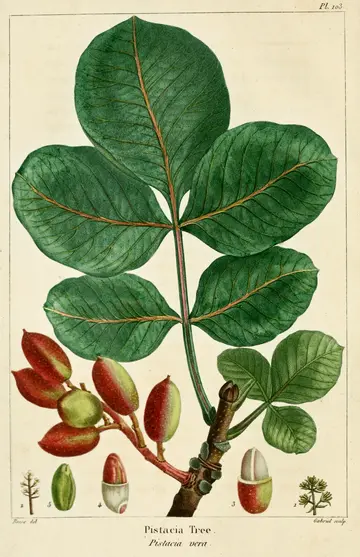
Image wanted. A licensed image will be added when found.
How to tell them apart
Side by side
| Pistachio | Terebinth | |
|---|---|---|
| Scientific name | Pistacia vera | Pistacia terebinthus |
| Family | Anacardiaceae (cashew family) | Anacardiaceae (cashew family) |
| Form | tree, perennial, deciduous | shrub or small tree, perennial, deciduous |
| Height | 5–10 m | 2–10 m |
| Flower colour | Red, Green | Red, Purple |
| Origin | Iran and Central Asia | Mediterranean basin |
| Toxicity | — | — |
| Flowering | ||
| Leaves | Compound leaves of 3–5 thick, leathery leaflets. | Odd-pinnate leaves 10–20 cm long with 5–11 glossy, oval leaflets, smelling of resin. |
| Flowers | Small flowers without petals in clusters; male and female flowers on separate trees, pollinated by wind. | Clusters of small, reddish-purple flowers in spring, with the leaves; male and female plants are separate. |
| Fruit and seeds | A hard-shelled nut inside a reddish outer husk; the shell often splits open by itself when ripe. | Small, round fruits 5–7 mm across, red at first and greenish-blue or black when ripe. |
All pairs: look-alike plants · Full pages: Pistachio, Terebinth