Description
Form
herbaceous, annual
Height: 0.5–1.5 m
Flower colour
YellowWhite
Flowering
No reliable data in the sources.
Leaves
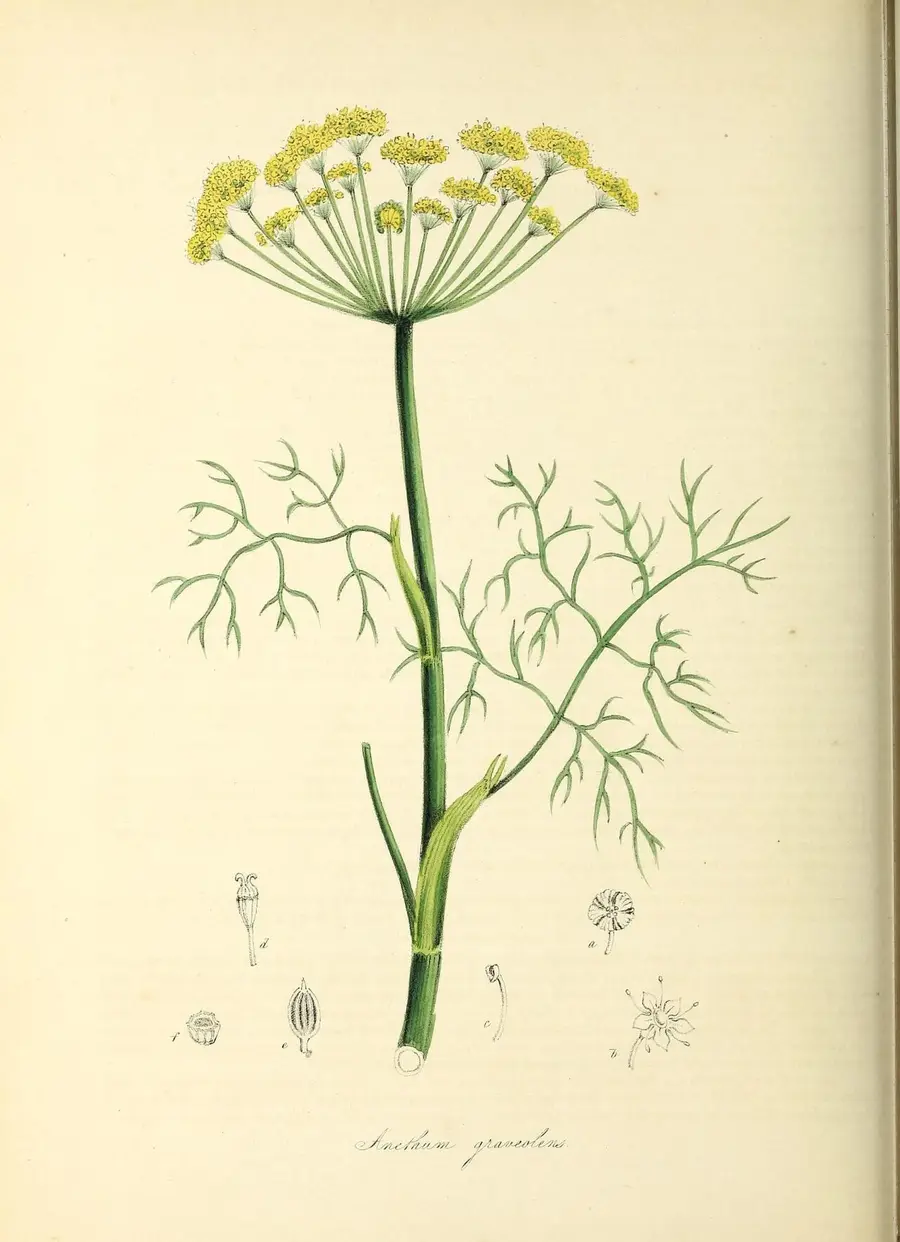
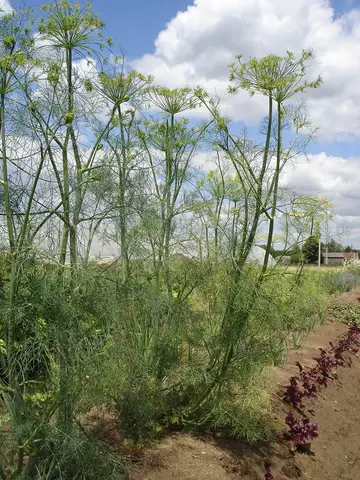
The stem is thin and hollow. Leaves 10–20 cm long are divided into thread-like segments only 1–2 mm wide.
Flowers
Small, white to yellow, fragrant flowers in umbrella-shaped heads 2.5–9 cm across. It runs to flower in hot, dry weather.
Fruit and seeds
Dry fruits 4–5 mm long and 1 mm thick, straight or slightly curved and ribbed lengthwise; these are the "dill seeds" used as a spice.
Classification
- KingdomPlantae
- PhylumTracheophyta
- ClassMagnoliopsida
- OrderApiales
- FamilyApiaceae
- GenusAnethum
- SpeciesAnethum graveolens
Native range
According to POWO it is native to Morocco, Algeria, Tunisia, Libya, Chad, Cyprus, Syria-Lebanon, Iran and the Arabian Peninsula. It is grown across most of Eurasia and has naturalised in many places.
Growing conditions
Light
Full sun.
Water
Regular.
Soil
Free-draining, fertile soil.
It has a taproot and dislikes transplanting; sow it where it is to grow. For leaves, repeat sowings a few weeks apart.
Culture and history
The name
The genus name Anethum comes from an ancient Greek word used for both dill and anise. Later anisum came to mean anise and anethum dill.
Toxicity
ASPCA lists dill as non-toxic to cats, dogs and horses. Its essential oils can irritate the skin on prolonged contact.
In an emergency call your local poison centre; for pets, contact a vet straight away. See also: plants and pets.
Look-alikes
- Fennel (Foeniculum vulgare): Its leaf segments are finer (under 1 mm) and stiffer; it is perennial and smells of aniseed. Compare side by side →
- Poison hemlock (Conium maculatum): Deadly poisonous member of the same family, with white umbrella-shaped flower heads too; it is much taller, its stem is smooth with purple blotches and it smells foul when crushed. Never pick wild plants of the carrot family. Compare side by side →
Questions
Are dill and fennel the same plant?
No. Both are in the carrot family but in different genera. Dill is annual; fennel is perennial with finer, stiffer leaves.
Is dill toxic to cats?
ASPCA lists dill as non-toxic to cats, dogs and horses.
Dill: how do you grow it?
Light: Full sun. Water: Regular. Soil: Free-draining, fertile soil. It has a taproot and dislikes transplanting; sow it where it is to grow. For leaves, repeat sowings a few weeks apart.
Dill: what is its scientific name?
Anethum graveolens L., in the genus Anethum and the family Apiaceae.
Sources
- Wikipedia: Dill
- World Flora Online
- Plants of the World Online (Kew) · native range (WCVP)
- GBIF · classification
- Wikidata
- ASPCA Animal Poison Control: Dill
Checked: 2026-11-17. Spotted a mistake? Tell us.