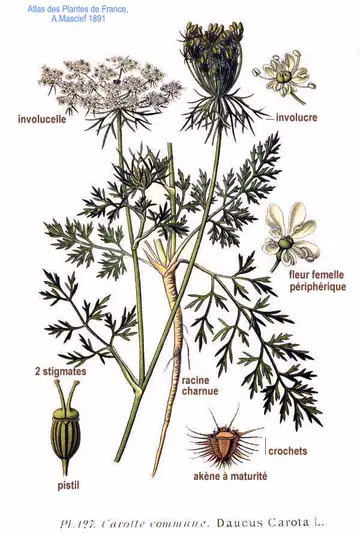
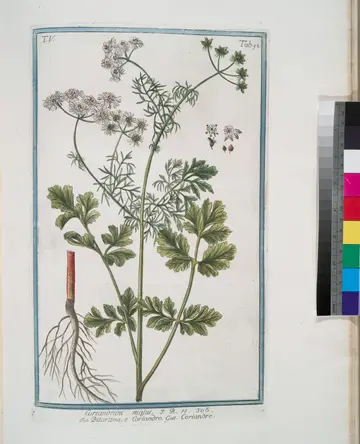
Description
Form
herbaceous, biennial
Height: Flower stems 30–60 cm
Flower colour
WhitePink
Flowering
June–July
Leaves
Finely divided, feathery leaves with thread-like segments, on stems 20–30 cm tall.
Flowers
Small white or pink flowers in compound umbels of 5–16 unequal rays, each 1–6 cm long.
Fruit and seeds
Smooth, crescent-shaped, laterally flattened dry fruits about 3 mm long, with five pale ridges and a pleasant smell when crushed.
Classification
- KingdomPlantae
- PhylumTracheophyta
- ClassMagnoliopsida
- OrderApiales
- FamilyApiaceae
- GenusCarum
- SpeciesCarum carvi
Native range
According to POWO it is native to most of Europe, Türkiye, the Caucasus, Iraq, Iran, Central Asia, the Himalaya, Mongolia, northern and central China and from Siberia to the Russian Far East.
Growing conditions
Light
A warm, sunny spot.
Soil
Well-drained soil rich in organic matter.
In warm regions it is sown in winter as an annual; in temperate climates it is grown as a summer annual or a biennial.
Culture and history
The spice in rye bread
According to Wikipedia the fruits are usually used whole in breads, especially rye bread; their flavour comes mostly from the essential oils carvone and limonene.
Toxicity
ASPCA lists caraway as toxic to cats, dogs and horses. The toxic principles are oils, carvone and limonene; signs are mild vomiting and diarrhoea.
In an emergency call your local poison centre; for pets, contact a vet straight away. See also: plants and pets.
Look-alikes
- Cumin (Cuminum cyminum): A spice plant of the same family but a different genus, and the two names are often confused. Cumin is an annual 20–50 cm tall; caraway is a biennial with flower stems 30–60 cm tall and crescent-shaped fruits. Compare side by side →
Questions
Are caraway and cumin the same?
No. Both belong to the carrot family but to different genera: cumin is Cuminum cyminum and caraway is Carum carvi. Caraway is a biennial with crescent-shaped fruits.
Caraway: when does it flower?
In summer: June–July. Months are for temperate northern-hemisphere climates and shift with altitude and weather.
Caraway: how do you grow it?
Light: A warm, sunny spot. Soil: Well-drained soil rich in organic matter. In warm regions it is sown in winter as an annual; in temperate climates it is grown as a summer annual or a biennial.
Caraway: is it toxic to cats and dogs?
Toxic to cats and dogs. Oils: mild vomiting, diarrhoea.
Caraway: what is its scientific name?
Carum carvi L., in the genus Carum and the family Apiaceae.
Sources
- Wikipedia: Caraway
- ASPCA Animal Poison Control: Caraway
- Plants of the World Online (Kew) · native range (WCVP)
- GBIF · classification
- Wikidata
- Wikispecies: Carum carvi
Checked: 2026-11-23. Spotted a mistake? Tell us.