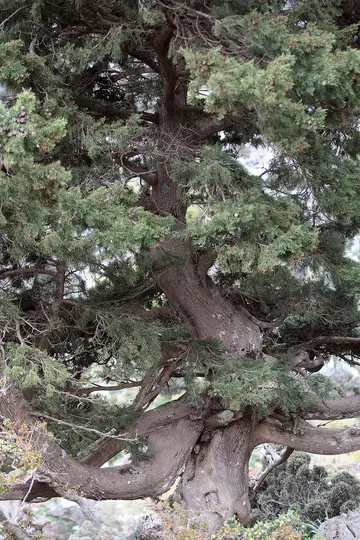
Description
Form
shrub or small tree, perennial, evergreen
Height: From a prostrate shrub to 10 m, rarely 16 m
Flowering
No reliable data in the sources.
Leaves
Sharp, prickly needles about 1.5 cm long in whorls of three, with a single white stomatal band on the inner surface. Unlike other junipers it never forms scale leaves.
Flowers
Male and female cones are on separate plants. The yellow male cones, 2–3 mm long, shed their pollen in March and April.
Fruit and seeds
Berry-like cones (juniper berries), green at first and ripening in about 18 months to purple-black with a blue waxy coating; spherical, 4–12 mm across, usually with three seeds. Birds spread the seeds.
Classification
- KingdomPlantae
- PhylumTracheophyta
- ClassPinopsida
- OrderPinales
- FamilyCupressaceae
- GenusJuniperus
- SpeciesJuniperus communis
Native range
According to POWO it is native across much of the northern hemisphere, from North America through Europe, North Africa, Türkiye, Central Asia and the Himalaya to Siberia and Japan.
IUCN Red List status: Least concern (LC).
Culture and history
2,000-year-old males
According to Wikipedia male plants live longer than females; a male juniper can live for more than 2,000 years.
Juniper berries
According to the Turkish Wikipedia its berry-like cones are used in the drinks industry, and its wood, with yellow sapwood and dark heartwood, is used for turning.
Look-alikes
- Greek juniper (Juniperus excelsa): On older branches its leaves are small, scale-like and pressed to the shoot, and it is a tree of 5–20 m. Common juniper never forms scale leaves; its leaves are sharp needles in whorls of three. Compare side by side →
Questions
How do you tell common juniper from Greek juniper?
By the leaves: common juniper has sharp needles in whorls of three and never forms scale leaves, while Greek juniper has small, scale-like leaves pressed to its older branches.
Common juniper: what is its scientific name?
Juniperus communis L., in the genus Juniperus and the family Cupressaceae.
Sources
- Wikipedia: Juniperus communis
- Plants of the World Online (Kew) · native range (WCVP)
- GBIF · classification
- Wikidata
Checked: 2026-11-24. Spotted a mistake? Tell us.