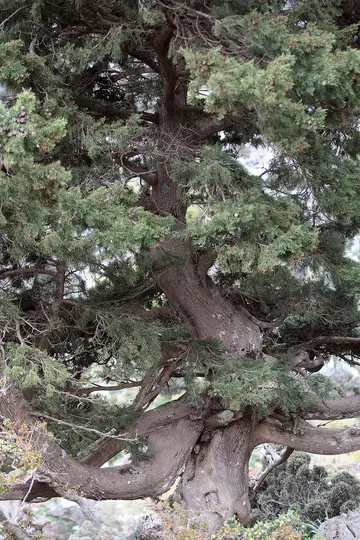
Description
Form
tree, perennial, evergreen
Height: 20–25 m
Flowering
No reliable data in the sources.
Habitat
Leaves
Scale leaves about 1 mm long, pressed against the twig, on flattened, slightly aromatic sprays.
Flowers
Does not flower; it bears cones.
Fruit and seeds
Cones about 2 cm long with eight scales; as a hybrid its seeds are mostly sterile. Over time the cones dry, shrink and turn grey or chocolate brown.
Classification
- KingdomPlantae
- PhylumTracheophyta
- ClassPinopsida
- OrderPinales
- FamilyCupressaceae
- GenusCupressus
- SpeciesCupressus × leylandii
Native range
It has no native range: according to Wikipedia the wild ranges of its two parents are more than 640 km apart, and the hybrid arose in 1888 in a garden when female cones of Nootka cypress were fertilised by Monterey cypress pollen. Nearly all trees seen today were propagated from cuttings.
Growing conditions
Light
Full sun.
According to Wikipedia it can reach 15 m in 16 years even on poor sites.
Look-alikes
- Mediterranean cypress (Cupressus sempervirens): Same genus with scale leaves too, but its cones are larger (2–4 cm), round, woody and made of 10–14 shield-shaped scales. Compare side by side →
- Oriental arborvitae (Platycladus orientalis): Also a scale-leaved hedge plant, but its flattened sprays stand in vertical fans. Compare side by side →
Questions
How did the Leyland cypress arise?
According to Wikipedia it is a chance hybrid that arose in Britain in 1888, when Nootka cypress was fertilised by Monterey cypress pollen; most trees today come from cuttings.
Leyland cypress: how do you grow it?
Light: Full sun. According to Wikipedia it can reach 15 m in 16 years even on poor sites.
Leyland cypress: what is its scientific name?
Cupressus × leylandii A.B.Jacks. & Dallim., in the genus Cupressus and the family Cupressaceae.
Sources
- Wikipedia: Leyland cypress
- World Flora Online
- GBIF · classification
Checked: 2026-11-22. Spotted a mistake? Tell us.