Description
Form
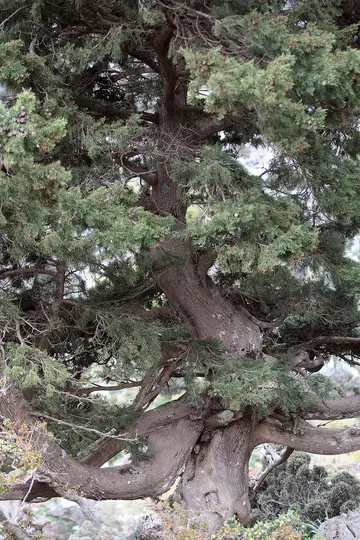
tree, perennial, evergreen
Height: 5–20 m
Flower colour
Green
Flowering
March–April
Habitat
Leaves
On older branches the leaves are small, scale-like and pressed tightly to the twig; young plants also have needle-like leaves.
Flowers
Tiny male and female cones, wind-pollinated.
Fruit and seeds
Pea-sized (8–12 mm), fleshy, bluish-black, bloomy "juniper berries", which are actually cones made of fleshy scales; they take two years to ripen.
Classification
- KingdomPlantae
- PhylumTracheophyta
- ClassPinopsida
- OrderPinales
- FamilyCupressaceae
- GenusJuniperus
- SpeciesJuniperus excelsa
Native range
According to POWO it is native to the Balkans (Albania, Bulgaria, Greece), the Crimea, the Caucasus, Türkiye, Cyprus, Lebanon-Syria and Palestine.
IUCN Red List status: Least concern (LC).
Culture and history
Durable wood
Juniper wood is fragrant and rot-resistant; for centuries it was used in Anatolia to build houses and mosques, especially in mountain villages.
Look-alikes
- Stinking juniper (Juniperus foetidissima): Grows in the same mountains; its twigs are thicker and irregular, and its scale leaves smell very sharp when crushed.
- Prickly juniper (Juniperus oxycedrus): Its leaves are sharp needles with two white lines on top, not scales; its berries are reddish-brown when ripe.
- Mediterranean cypress (Cupressus sempervirens): Its leaves are also tiny scales pressed against the shoot, but its cones are round, woody, 2–4 cm across and made of shield-shaped scales. Juniper "berries" are pea-sized, fleshy and blue-black. Compare side by side →
Questions
Where does Greek juniper grow in Türkiye?
Especially in the Taurus Mountains, the Lakes Region and on the dry, rocky slopes of the Central Anatolian mountains.
Greek juniper: when does it flower?
In spring: March–April. Months are for temperate northern-hemisphere climates and shift with altitude and weather.
Greek juniper: what is its scientific name?
Juniperus excelsa M.Bieb., in the genus Juniperus and the family Cupressaceae.
Sources
- Wikipedia: Juniperus excelsa
- World Flora Online
- Plants of the World Online (Kew) · native range (WCVP)
- GBIF · classification
- Wikidata
Checked: 2026-11-17. Spotted a mistake? Tell us.