Description
Form
climber, perennial, deciduous
Height: Climbs several metres
Flower colour
White
Flowering
June–September
Habitat
Leaves
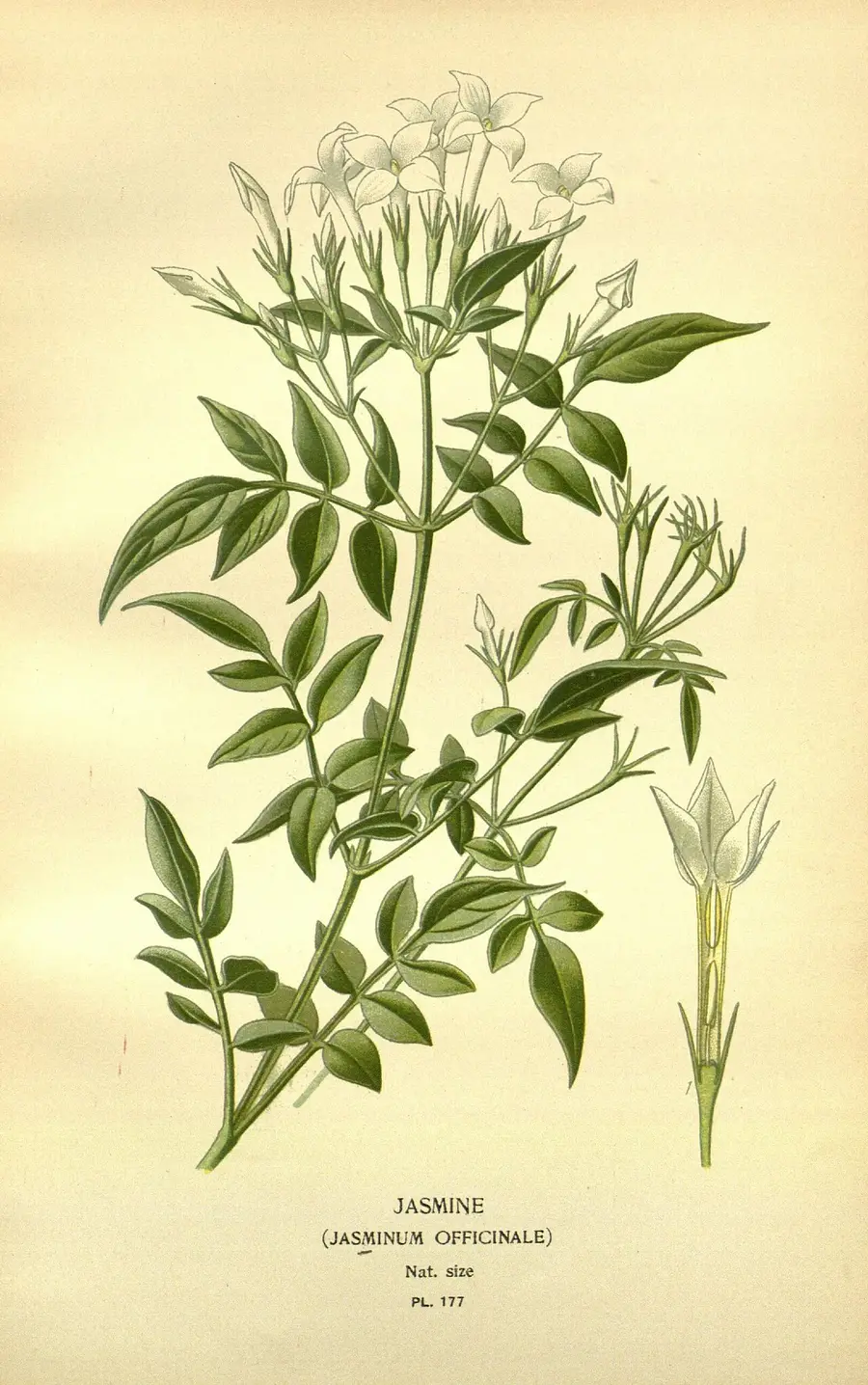
Opposite, compound leaves of 5–9 small, pointed leaflets.
Flowers
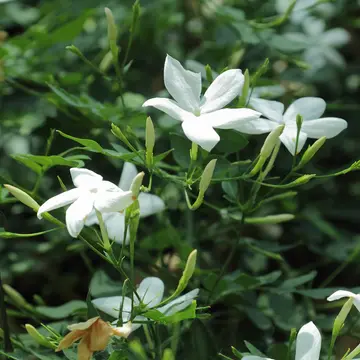
White, long-tubed, five-lobed star-shaped flowers in clusters at the shoot tips; the scent is strongest in the evening.
Fruit and seeds
A small black berry, rarely formed in cultivation.
Classification
- KingdomPlantae
- PhylumTracheophyta
- ClassMagnoliopsida
- OrderLamiales
- FamilyOleaceae
- GenusJasminum
- SpeciesJasminum officinale
Native range
According to POWO it is native to Türkiye, the Caucasus, Iran, Afghanistan, Pakistan, Tajikistan, the Himalaya, Tibet, Myanmar and south-central China. Because it has been grown for so long, its original home is uncertain. It is naturalised in southern Europe, North Africa, Florida and the West Indies.
Growing conditions
Light
Sun or partial shade.
Water
Moderate.
Soil
Free-draining, fertile soil.
Temperature
Tolerates light frost.
Needs wire, a fence or a pergola to climb; prune after flowering.
Culture and history
Perfume
Jasmine is one of the basic floral notes in perfumery. Oil from the flowers is very valuable; today part of this scent is made synthetically.
National flower of Pakistan
Jasmine is Pakistan's national flower. It was so well established in Europe that Linnaeus thought it was native to Switzerland.
Toxicity
ASPCA lists the jasmine genus (Jasminum) as non-toxic to cats, dogs and horses.
In an emergency call your local poison centre; for pets, contact a vet straight away. See also: plants and pets.
Look-alikes
- Carolina jessamine (Gelsemium sempervirens): Sometimes called "yellow jasmine" but not a true jasmine, and highly poisonous; its flowers are yellow trumpets.
- Star jasmine (Trachelospermum jasminoides): An evergreen, fragrant white-flowered climber with simple, leathery leaves and milky sap.
Questions
Is jasmine toxic to cats?
No. ASPCA lists true jasmines (Jasminum) as non-toxic to cats and dogs. "Yellow jasmine" (Gelsemium) is a completely different, highly poisonous plant.
Common jasmine: when does it flower?
In summer and autumn: June–September. Months are for temperate northern-hemisphere climates and shift with altitude and weather.
Common jasmine: how do you grow it?
Light: Sun or partial shade. Water: Moderate. Soil: Free-draining, fertile soil. Temperature: Tolerates light frost.
Common jasmine: when and how do you prune it?
Needs wire, a fence or a pergola to climb; prune after flowering.
Common jasmine: what is its scientific name?
Jasminum officinale L., in the genus Jasminum and the family Oleaceae.
Sources
- Wikipedia: Jasminum officinale
- World Flora Online
- Plants of the World Online (Kew) · native range (WCVP)
- GBIF · classification
- Wikidata
- ASPCA Animal Poison Control: Jasmine (Jasminum)
Checked: 2026-11-16. Spotted a mistake? Tell us.