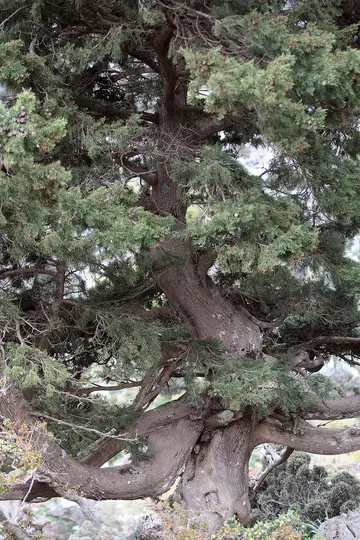
Description
Form
tree, perennial, evergreen
Height: 60–115 m
Flower colour
Green
Flowering
January–March
Habitat
Leaves
On side shoots the leaves are flat and needle-like in two rows, with two white lines underneath; on top shoots they are small and scale-like.
Flowers
Small male and female cones that open in late winter and are wind-pollinated.
Fruit and seeds
Small (1.5–3 cm), egg-shaped cones.
Classification
- KingdomPlantae
- PhylumTracheophyta
- ClassPinopsida
- OrderPinales
- FamilyCupressaceae
- GenusSequoia
- SpeciesSequoia sempervirens
Native range
According to POWO it is native only to the Pacific coast of North America, in California and southern Oregon. Its native range is a narrow strip, fed by summer fogs, reaching about 50 km inland.
IUCN Red List status: Endangered (EN).
Culture and history
Hyperion
A coast redwood named "Hyperion", measured in 2006 in Redwood National Park, California, is the tallest known living tree at about 116 metres.
Why endangered?
Most natural redwood forest was logged in the 19th and 20th centuries, and only a small share of old-growth forest remains. The IUCN therefore assesses the species as Endangered.
Look-alikes
- Giant sequoia (Sequoiadendron giganteum): Grows in the Sierra Nevada; the largest tree in the world by mass, but not as tall as the coast redwood. Its leaves are scale- or awl-like, not flat.
- Dawn redwood (Metasequoia glyptostroboides): From China and deciduous in winter; often planted in parks.
Questions
What is the tallest tree in the world?
The tallest known living tree is a coast redwood (Sequoia sempervirens) in California named "Hyperion", about 116 metres tall.
Coast redwood: when does it flower?
In winter and spring: January–March. Months are for temperate northern-hemisphere climates and shift with altitude and weather.
Coast redwood: what is its scientific name?
Sequoia sempervirens (D.Don) Endl., in the genus Sequoia and the family Cupressaceae.
Sources
- Wikipedia: Sequoia sempervirens
- World Flora Online
- Plants of the World Online (Kew) · native range (WCVP)
- GBIF · classification
- Wikidata
Checked: 2026-11-17. Spotted a mistake? Tell us.