Description
Form
herbaceous, perennial
Height: 30–90 cm
Flower colour
YellowWhitePinkPurpleRedOrange
Flowering
October–November
Habitat
Leaves
Alternate, lobed, toothed leaves up to 12 cm long, covered in grey hairs and sharply scented when crushed.
Flowers
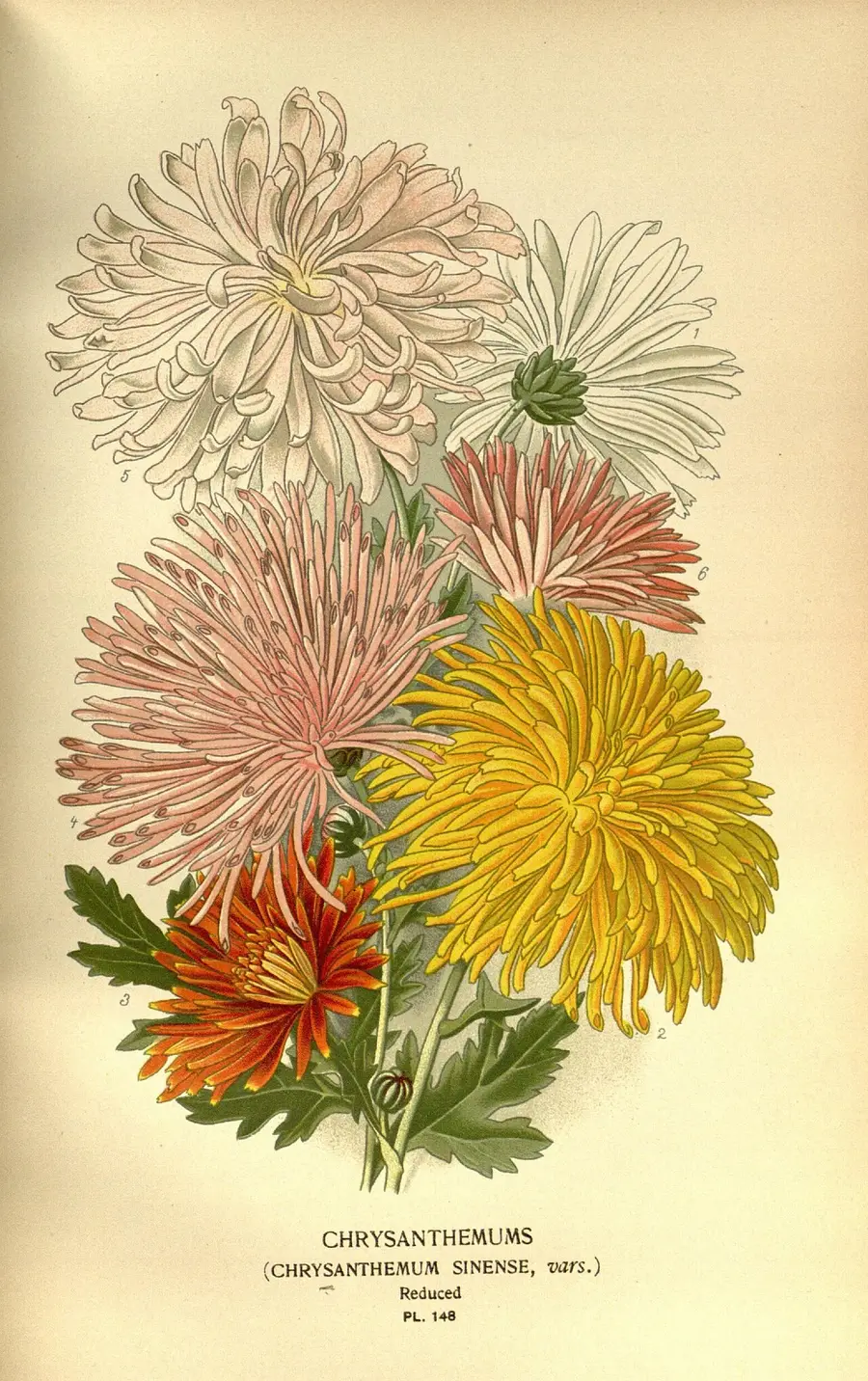
The typical daisy-family flower head, with disc florets in the centre and ray florets around the edge. In cultivars the heads range from button-size to 20 cm, and may be single, ball-shaped, spider-shaped and much more.
Fruit and seeds
Cultivars rarely set seed.

Classification
- KingdomPlantae
- PhylumTracheophyta
- ClassMagnoliopsida
- OrderAsterales
- FamilyAsteraceae
- GenusChrysanthemum
- SpeciesChrysanthemum × morifolium
Native range
It has no wild range. It arose in ancient China by crossing wild Chrysanthemum species, above all C. indicum. It is mentioned in China from about 500 BC, was known in the Netherlands by the mid-17th century but became widespread in Europe only in the 19th century.
Growing conditions
Light
Full sun.
Water
Moderate; keep the soil moist.
Soil
Fertile, free-draining soil.
Temperature
Garden varieties tolerate light frost; pot varieties are usually grown for one season.
Pinching out the shoot tips a few times in spring makes the plant bushier and more floriferous.
Culture and history
Emblem of Japan
A sixteen-petalled chrysanthemum is the crest of the Japanese imperial family, and the imperial throne is called the Chrysanthemum Throne.
Tens of thousands of varieties
More than 500 varieties were recorded in China by 1630. Today there are estimated to be 20,000–30,000 varieties developed in China, Japan and Europe.
Toxicity
ASPCA lists the genus Chrysanthemum as toxic to cats, dogs and horses. It contains irritants such as sesquiterpene lactones and pyrethrins; signs include vomiting, diarrhoea, drooling, incoordination and skin irritation.
In an emergency call your local poison centre; for pets, contact a vet straight away. See also: plants and pets.
Look-alikes
- German chamomile: A relative, but an annual with small flower heads that flowers in spring and summer. Compare side by side →
Questions
When do chrysanthemums flower?
In autumn, in October and November; they flower as the nights get longer.
Chrysanthemum: how do you grow it?
Light: Full sun. Water: Moderate; keep the soil moist. Soil: Fertile, free-draining soil. Temperature: Garden varieties tolerate light frost; pot varieties are usually grown for one season.
Chrysanthemum: when and how do you prune it?
Pinching out the shoot tips a few times in spring makes the plant bushier and more floriferous.
Chrysanthemum: is it toxic to cats and dogs?
Toxic to cats and dogs. Pyrethrins, lactones: vomiting, drooling.
Chrysanthemum: what is its scientific name?
Chrysanthemum × morifolium (Ramat.) Hemsl., in the genus Chrysanthemum and the family Asteraceae.
Sources
- Wikipedia: Chrysanthemum × morifolium
- World Flora Online
- GBIF · classification
- ASPCA Animal Poison Control: Chrysanthemum
- Wikipedia
Checked: 2026-11-16. Spotted a mistake? Tell us.