Description
Form
herbaceous, annual
Height: 15–60 cm
Flower colour
WhiteYellow
Flowering
April–August
Leaves
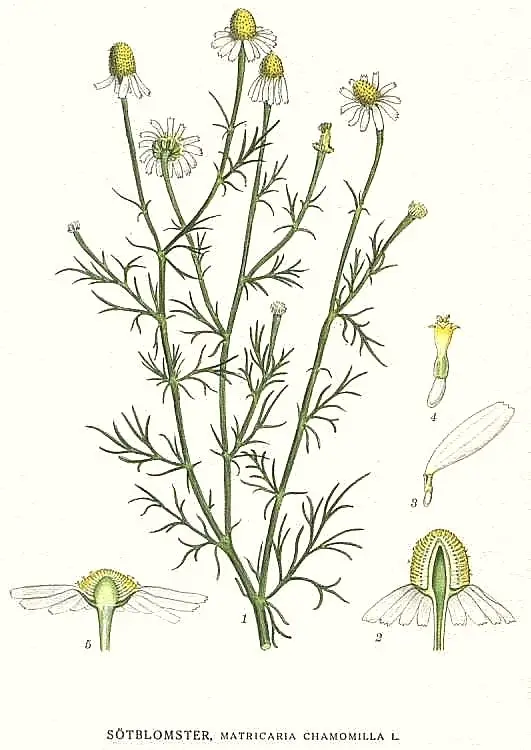
Leaves two or three times divided into very fine, almost thread-like segments.
Flowers
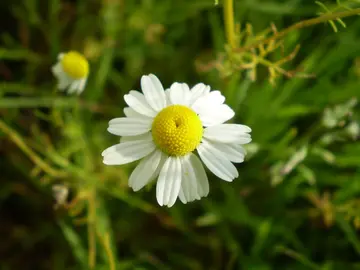
Each head has yellow disc florets in the centre and white ray florets around the edge. The base of the head (receptacle) is cone-shaped and hollow. The rays bend downwards as the head matures.
Fruit and seeds
A tiny, dry, one-seeded fruit (achene).
Classification
- KingdomPlantae
- PhylumTracheophyta
- ClassMagnoliopsida
- OrderAsterales
- FamilyAsteraceae
- GenusMatricaria
- SpeciesMatricaria chamomilla
Native range
According to POWO it is native over a wide area: most of Europe, the Mediterranean Basin, Türkiye, the Caucasus, Iran and Central Asia to China. It has been introduced and gone wild in many parts of the Americas, Australia and Africa.
Growing conditions
Light
Full sun.
Water
Low to moderate.
Soil
Not fussy; does well in sandy, free-draining soil.
Temperature
Likes cool spring conditions.
The seeds are tiny and need light to germinate, so scatter them on the surface.
Culture and history
Chamomile tea
The dried flower heads are steeped in hot water as a tea. Chamomile has been grown and gathered for centuries in Europe and Anatolia.
Loves me, loves me not
Plucking the rays one by one while saying "loves me, loves me not" is a folk game known from Europe to Türkiye.
Toxicity
People allergic to the daisy family (for example to ragweed) may also react to chamomile. ASPCA's "chamomile" entry is for a different species, Roman chamomile (Chamaemelum nobile), which it lists as toxic to cats, dogs and horses; there is no separate entry for Matricaria chamomilla.
In an emergency call your local poison centre; for pets, contact a vet straight away. See also: plants and pets.
Look-alikes
- Scentless mayweed (Tripleurospermum): Its receptacle is solid and it has almost no scent. Cutting the head in half and finding it solid is the easiest test.
- Dog fennels (Anthemis): Small scales on a solid receptacle; many species smell unpleasant.
Questions
How do you tell chamomile from scentless mayweed?
True chamomile (Matricaria chamomilla) has a cone-shaped yellow receptacle that is hollow when cut in half; scentless mayweed's is solid.
German chamomile: when does it flower?
In spring and summer: April–August. Months are for temperate northern-hemisphere climates and shift with altitude and weather.
German chamomile: how do you grow it?
Light: Full sun. Water: Low to moderate. Soil: Not fussy; does well in sandy, free-draining soil. Temperature: Likes cool spring conditions. The seeds are tiny and need light to germinate, so scatter them on the surface.
German chamomile: what is its scientific name?
Matricaria chamomilla L., in the genus Matricaria and the family Asteraceae.
Sources
- Wikipedia: Matricaria chamomilla
- World Flora Online
- Plants of the World Online (Kew) · native range (WCVP)
- GBIF · classification
- Wikidata
- ASPCA: Chamomile (Anthemis nobilis)
Checked: 2026-11-16. Spotted a mistake? Tell us.