Description
Form
herbaceous, perennial
Height: Up to 1.5 m
Flower colour
BluePurpleWhitePink
Flowering
March–October
Habitat
Leaves
Stalked, lance-shaped, unlobed leaves 7.5–32 cm long (smallest near the top) and 2–8 cm wide. The stem is tough, grooved and more or less hairy.
Flowers
Flower heads 3–5 cm wide, usually light blue or lavender, rarely white or pink.
Fruit and seeds
Small dry seeds with tiny scales at the tip.
Classification
- KingdomPlantae
- PhylumTracheophyta
- ClassMagnoliopsida
- OrderAsterales
- FamilyAsteraceae
- GenusCichorium
- SpeciesCichorium intybus
Native range
According to POWO it is native to most of Europe, the Mediterranean basin, North Africa, Türkiye and western and Central Asia, and has spread to many parts of the world.
Culture and history
The root
According to Wikipedia, around 1970 the root was found to contain up to 20% inulin, which is now used in food manufacturing as a sweetener and source of fibre.
Look-alikes
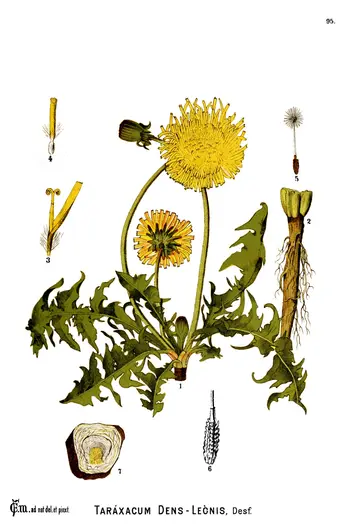
- Common dandelion (Taraxacum officinale): Also a member of the daisy family, but its leaves form a ground-level rosette with deep, backward-pointing teeth, it bears a single yellow head on a leafless hollow stalk, and its seeds have parachutes. Chicory has blue flowers and a tough, branched stem. Compare side by side →
Questions
Are chicory and dandelion the same plant?
No. Both are in the daisy family but in different genera: chicory has blue flowers (Cichorium intybus), dandelion yellow ones (Taraxacum officinale).
Chicory: when does it flower?
In spring and summer and autumn: March–October. Months are for temperate northern-hemisphere climates and shift with altitude and weather.
Chicory: what is its scientific name?
Cichorium intybus L., in the genus Cichorium and the family Asteraceae.
Sources
- Wikipedia: Chicory
- World Flora Online
- Plants of the World Online (Kew) · native range (WCVP)
- GBIF · classification
- Wikidata
Checked: 2026-11-22. Spotted a mistake? Tell us.