Description
Form
herbaceous, perennial
Height: 5–40 cm
Flower colour
Yellow
Flowering
March–October
Leaves
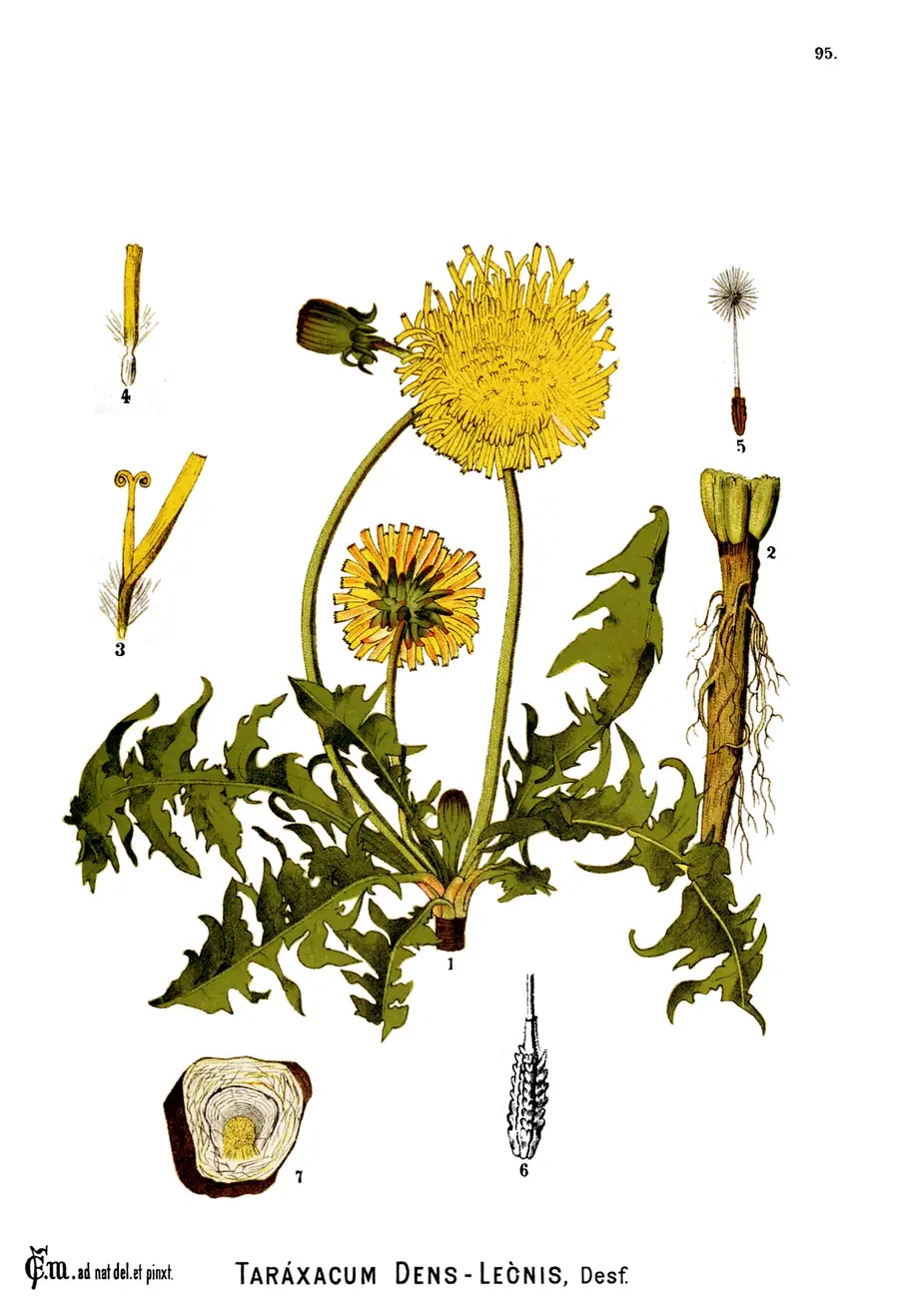
Leaves in a low rosette, deeply cut into backward-pointing teeth. Its name in many languages ("lion's tooth", dent-de-lion) comes from these teeth.
Flowers
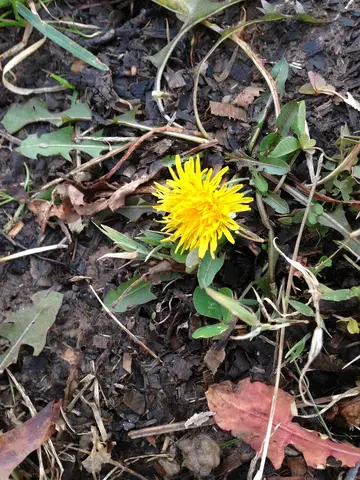
A single yellow flower head at the top of a leafless, hollow stalk. Each "petal" is actually a separate flower; one head holds hundreds of strap-shaped florets.
Fruit and seeds
Each seed carries a fluffy parachute; the ripe head becomes a white ball, and the seeds can be carried kilometres by the wind.
Classification
- KingdomPlantae
- PhylumTracheophyta
- ClassMagnoliopsida
- OrderAsterales
- FamilyAsteraceae
- GenusTaraxacum
- SpeciesTaraxacum officinale
Native range
Taraxacum officinale is not a single species but a group of many closely related "microspecies", most of which produce seed without fertilisation. POWO treats the name as a group name, native to Europe, around the Mediterranean, Türkiye and western Asia east to Siberia. It has spread to almost every temperate region in the world.
Culture and history
Seed without sex
Most dandelions produce their seeds without fertilisation, by a process called apomixis, so each seed is a copy of the mother plant. This is why the group is split into hundreds of very similar microspecies.
Look-alikes
- Cat's-ears and hawk's-beards (Hypochaeris and Crepis species): They also have yellow flower heads, but their stalks usually branch and may be solid. A dandelion has a single head on each hollow stalk.
Questions
How do dandelion seeds spread?
Each seed has a fluffy parachute at its tip; the wind can carry the seeds for kilometres.
Is the dandelion a single species?
No. The name Taraxacum officinale covers a group of hundreds of very similar microspecies, most of which produce seed without fertilisation.
Common dandelion: when does it flower?
In spring and summer and autumn: March–October. Months are for temperate northern-hemisphere climates and shift with altitude and weather.
Common dandelion: what is its scientific name?
Taraxacum officinale F.H.Wigg., in the genus Taraxacum and the family Asteraceae.
Sources
- Wikipedia: Taraxacum officinale
- Plants of the World Online (Kew) · native range (WCVP)
- GBIF · classification
- Wikidata
Checked: 2026-11-17. Spotted a mistake? Tell us.