Telling them apart
Black poplar vs White willow
Black poplar (Populus nigra) and White willow (Salix alba) look similar enough to be confused. Both belong to the same family, Salicaceae (willow family).
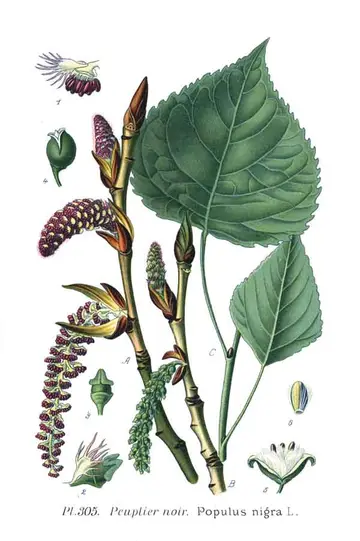
Image wanted. A licensed image will be added when found.
How to tell them apart
- Black poplar: Also a waterside tree whose seeds drift on cottony hairs, but its leaves are triangular to diamond-shaped on long, flattened stalks that make them tremble in the slightest breeze. White willow leaves are narrow and lance-shaped, silky white underneath.
Side by side
| Black poplar | White willow | |
|---|---|---|
| Scientific name | Populus nigra | Salix alba |
| Family | Salicaceae (willow family) | Salicaceae (willow family) |
| Form | tree, perennial, deciduous | tree, perennial, deciduous |
| Height | 20–30 m | 10–30 m |
| Flower colour | Red, Green | Yellow, Green |
| Origin | Europe, North Africa and western-central Asia | Europe, western and Central Asia |
| Toxicity | — | — |
| Flowering | ||
| Leaves | Triangular or diamond-shaped, toothed leaves 5–8 cm long on long stalks. Because the stalk is flattened, the leaves tremble in the slightest breeze. | Narrow, lance-shaped leaves 5–10 cm long and 0.5–1.5 cm wide, covered with silky white hairs, especially beneath. |
| Flowers | Male and female flowers on separate trees. Male catkins are reddish, female ones greenish; they open before the leaves. | Catkins 3–5 cm long in early spring, male and female on separate trees; insect-pollinated. |
| Fruit and seeds | Small capsules that release masses of cottony, hairy seeds when ripe. This "poplar cotton" comes only from female trees. | Small 4 mm capsules on female catkins, releasing tiny seeds wrapped in cottony hairs in midsummer. |
All pairs: look-alike plants · Full pages: Black poplar, White willow