Description
Form
tree, perennial, deciduous
Height: 10–25 m
Flower colour
Green
Flowering
April–May
Leaves
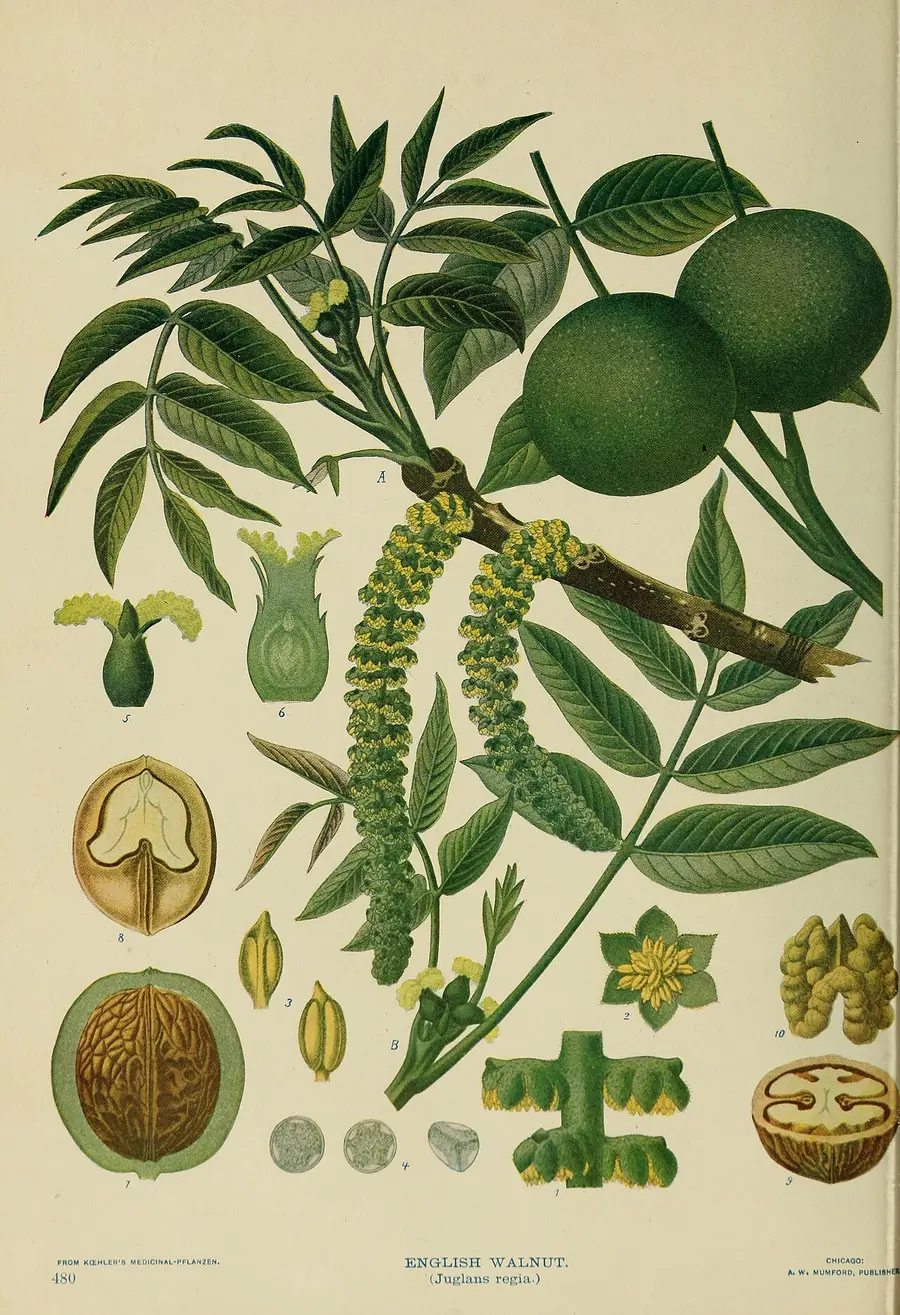
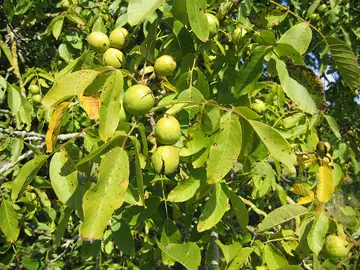
Compound leaves 20–45 cm long with 5–9 (most often 7) oval leaflets, strongly and pleasantly aromatic when crushed.
Flowers
Male flowers in long, hanging green catkins; female flowers 2–5 at the shoot tips, small and hairy. Wind-pollinated.
Fruit and seeds
A hard, wrinkled nut inside a green, fleshy husk that blackens and splits when ripe; the husk stains hands brown.
Classification
- KingdomPlantae
- PhylumTracheophyta
- ClassMagnoliopsida
- OrderFagales
- FamilyJuglandaceae
- GenusJuglans
- SpeciesJuglans regia
Native range
According to POWO it is native to Türkiye, Iraq, Iran, Lebanon–Syria, the Caucasus, Afghanistan, Pakistan and the western Himalaya, extending to Central Asia; the largest wild walnut forests are in Kyrgyzstan. It was taken to Europe and many other places very early.
IUCN Red List status: Least concern (LC).
Culture and history
Timber
Walnut wood is dark, hard and beautifully figured, prized for furniture, gunstocks and musical instruments.
Juglone
Walnut trees release juglone, which stunts the growth of some plants such as tomatoes, so vegetables struggle under a walnut.
Toxicity
Mouldy walnuts can contain mycotoxins dangerous to dogs, and walnut shavings can poison horses. Walnuts can cause severe allergic reactions in people with tree-nut allergies.
In an emergency call your local poison centre; for pets, contact a vet straight away. See also: plants and pets.
Look-alikes
- Black walnut (Juglans nigra): A North American species with a very thick, hard shell and more (15–23) toothed leaflets.
Questions
Why don't plants grow under walnut trees?
Walnuts release juglone, a compound that suppresses the growth of some plants, such as tomatoes.
Common walnut: when does it flower?
In spring: April–May. Months are for temperate northern-hemisphere climates and shift with altitude and weather.
Common walnut: what is its scientific name?
Juglans regia L., in the genus Juglans and the family Juglandaceae.
Sources
- Wikipedia: Juglans regia
- World Flora Online
- Plants of the World Online (Kew) · native range (WCVP)
- GBIF · classification
- Wikidata
Checked: 2026-11-16. Spotted a mistake? Tell us.