Description
Form
shrub, perennial, evergreen
Height: 15–30 cm
Flower colour
PurplePink
Flowering
No reliable data in the sources.
Habitat
Leaves
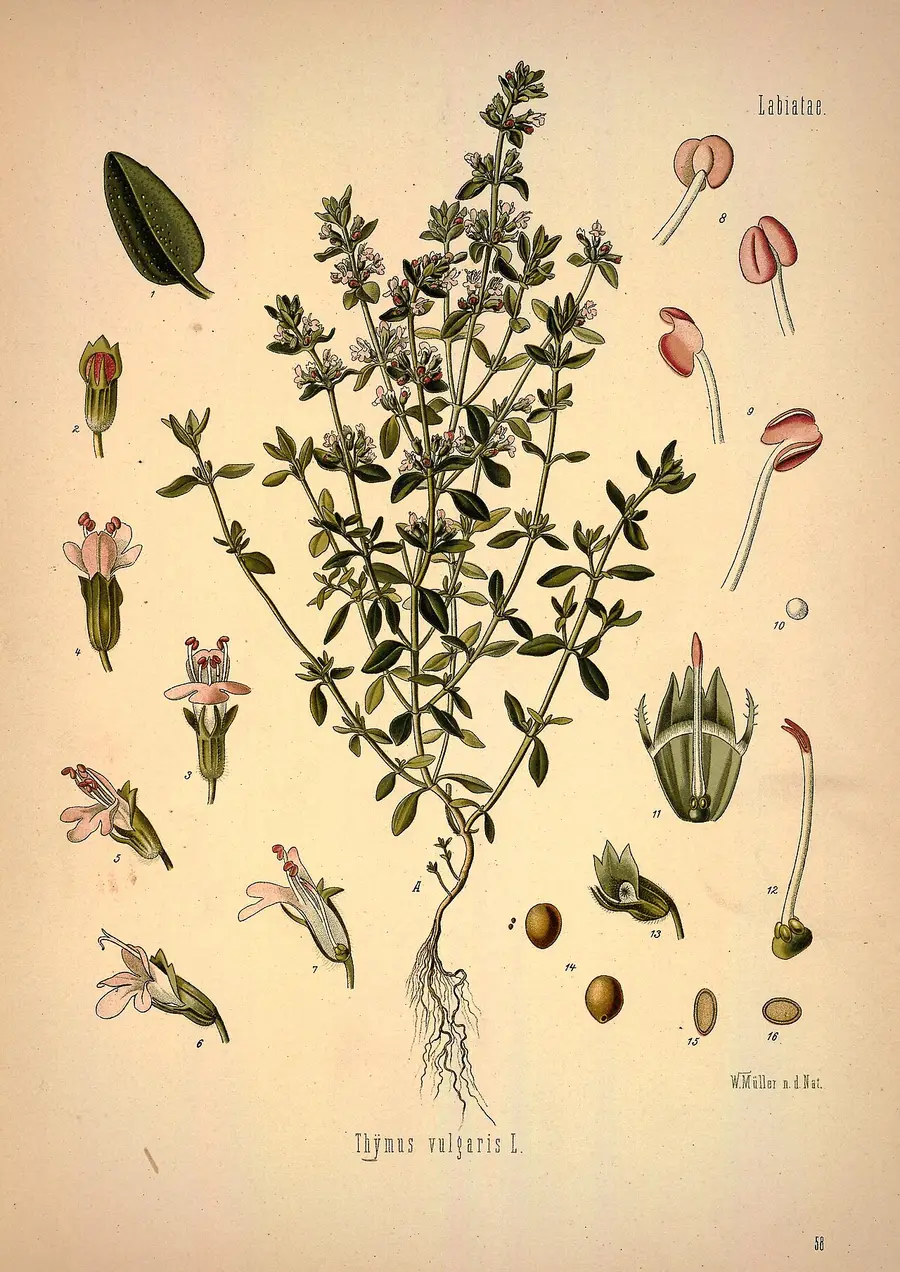
Very small, grey-green, strongly aromatic leaves.
Flowers
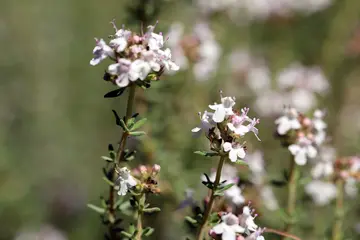
Small purple or pink flowers in clusters at the shoot tips, in early summer.
Fruit and seeds
A tiny dry fruit that splits into four nutlets.
Classification
- KingdomPlantae
- PhylumTracheophyta
- ClassMagnoliopsida
- OrderLamiales
- FamilyLamiaceae
- GenusThymus
- SpeciesThymus vulgaris
Native range
Native to southern Europe from the western Mediterranean to southern Italy. POWO lists Spain, the Balearic Islands, France and Italy.
IUCN Red List status: Least concern (LC).
Growing conditions
Light
Full sun.
Water
Little; drought tolerant, and roots rot in too much water.
Soil
Free-draining, sandy or stony soil.
Temperature
Hardy, but can rot in wet winter soil.
Can be short-lived as a ground cover; easy from cuttings.
Culture and history
Thymol
Thymol, one of the compounds that give thyme its scent, is named after the genus Thymus. The same compound occurs in other aromatic plants such as Turkish oregano.
Toxicity
ASPCA lists thyme (Thymus vulgaris) as non-toxic to cats, dogs and horses.
In an emergency call your local poison centre; for pets, contact a vet straight away. See also: plants and pets.
Look-alikes
- Turkish oregano (Origanum onites): The main plant sold as "kekik" in Türkiye; a different genus with larger, hairy leaves. Compare side by side →
- Za'atar (Thymbra spicata): An aromatic subshrub of Türkiye with flowers in spikes.
Questions
Is Turkish "kekik" the same as thyme?
Not always. In Türkiye "kekik" covers several aromatic plants, most often Turkish oregano (Origanum onites), not just Thymus vulgaris.
Common thyme: how do you grow it?
Light: Full sun. Water: Little; drought tolerant, and roots rot in too much water. Soil: Free-draining, sandy or stony soil. Temperature: Hardy, but can rot in wet winter soil.
Common thyme: how do you propagate it?
Can be short-lived as a ground cover; easy from cuttings.
Common thyme: is it toxic to cats and dogs?
Non-toxic to cats and dogs. Listed as non-toxic.
Common thyme: what is its scientific name?
Thymus vulgaris L., in the genus Thymus and the family Lamiaceae.
Sources
- Wikipedia: Thymus vulgaris
- World Flora Online
- Plants of the World Online (Kew) · native range (WCVP)
- GBIF · classification
- Wikidata
- ASPCA Animal Poison Control: Thyme
- Wikipedia: Thymol
Checked: 2026-11-16. Spotted a mistake? Tell us.