Description
Leaves
Alternate, pinnate leaves 30–45 cm long with 9–17 leaflets, each 5–12 cm long and 2–6 cm wide.
Fruit and seeds
Botanically not a true nut but a drupe: a husk 3–4 mm thick, green at first and brown when ripe, splits into four sections to release the thin-shelled seed.
Classification
- KingdomPlantae
- PhylumTracheophyta
- ClassMagnoliopsida
- OrderFagales
- FamilyJuglandaceae
- GenusCarya
- SpeciesCarya illinoinensis
Native range
According to POWO it is native to the south-central United States (Texas, Oklahoma, Arkansas, Louisiana, Mississippi, Missouri, Illinois, Indiana, Iowa, Kansas, Kentucky, Tennessee) and Mexico.
IUCN Red List status: Least concern (LC).
Culture and history
The name
According to Wikipedia the word "pecan" comes from Algonquian languages, where it referred to pecans, walnuts and hickory nuts. The pecan is the state tree of Texas.
Look-alikes
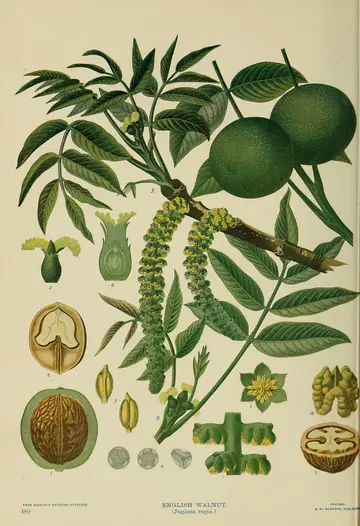
- Common walnut (Juglans regia): Same family (walnut family). Walnut leaves are 20–45 cm with mostly 5–9 leaflets, and its green husk blackens and cracks to reveal a wrinkled, hard-shelled nut. Pecan leaves have 9–17 leaflets and its shell is thin and smooth. Compare side by side →
Questions
Are pecan and walnut the same?
No. Both belong to the walnut family but to different genera: walnut is Juglans regia, pecan is Carya illinoinensis.
Pecan: what is its scientific name?
Carya illinoinensis (Wangenh.) K.Koch, in the genus Carya and the family Juglandaceae.
Sources
- Wikipedia: Pecan
- World Flora Online
- Plants of the World Online (Kew) · native range (WCVP)
- GBIF · classification
- Wikidata
Checked: 2026-11-22. Spotted a mistake? Tell us.