Description
Form
tree, perennial, semi-evergreen
Height: Up to 15 m
Flower colour
Green
Flowering
March–April
Habitat
Leaves
Oval leaves 4–9 cm long with 7–10 pairs of teeth and down-curled edges; glossy dark green above and grey-felted below.
Flowers
Light green male catkins 5 cm long and tiny female flowers in March–April; wind-pollinated.
Fruit and seeds
Oval acorns up to 5 cm long; the cup covers about a third of the acorn and is clothed in long, stiff, backward-curling scales. They ripen in the second autumn after pollination.
Classification
- KingdomPlantae
- PhylumTracheophyta
- ClassMagnoliopsida
- OrderFagales
- FamilyFagaceae
- GenusQuercus
- SpeciesQuercus ithaburensis
Native range
According to POWO it is native to south-eastern Italy, Albania, Bulgaria, Greece, Crete, the East Aegean islands, Türkiye (Anatolia and Thrace), Lebanon-Syria and Palestine.
IUCN Red List status: Least concern (LC).
Culture and history
A national tree
The Mount Tabor oak is the national tree of Jordan. According to Wikipedia, before the 20th century the Plain of Sharon in Israel was covered with open woodland of this oak.
Toxicity
ASPCA lists oaks (Quercus species) as toxic to horses. The toxin is gallotannin; signs are abdominal pain, constipation followed by diarrhoea, discoloured urine and jaundice. Acorns can also block the digestive tract.
In an emergency call your local poison centre; for pets, contact a vet straight away. See also: plants and pets.
Look-alikes
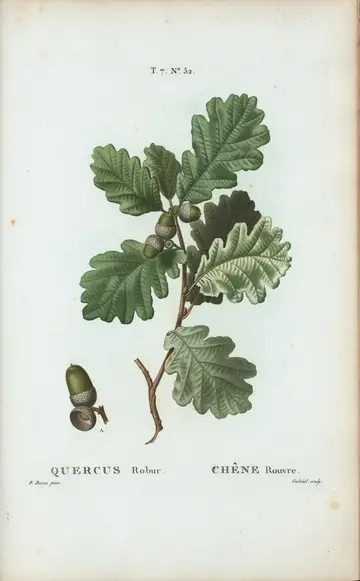
- English oak: Deciduous, with deeply lobed, hairless leaves; the scales of its acorn cups are flat and tight. Compare side by side →
- Turkey oak (Quercus cerris): In the same group, with long-scaled cups too, but its leaves are more deeply lobed and thinner and it is fully deciduous. Compare side by side →
Questions
How do I recognise the valonia oak?
By the grey-felted undersides of its leaves and the long, stiff, backward-curling scales on its acorn cups.
Valonia oak: when does it flower?
In spring: March–April. Months are for temperate northern-hemisphere climates and shift with altitude and weather.
Valonia oak: what is its scientific name?
Quercus ithaburensis Decne., in the genus Quercus and the family Fagaceae.
Sources
- Wikipedia: Quercus ithaburensis
- ASPCA: Oak
- World Flora Online
- Plants of the World Online (Kew) · native range (WCVP)
- GBIF · classification
- Wikidata
Checked: 2026-11-17. Spotted a mistake? Tell us.