Description
Form
tree, perennial, deciduous
Height: 20–30 m or more
Flower colour
BrownRed
Flowering
June
Habitat
Leaves
Leaves 6–12 cm long and 3–5 cm wide with five to nine pairs of lobes, the gaps between them reaching to or near the midrib. Dark green, rough and star-haired above, pale and densely hairy beneath.
Flowers
Male catkins appear in June from the base of the shoots, turning from yellowish-brown to red; female flowers are in groups of one to five on short, hairy stalks.
Fruit and seeds
A cylindrical, pointed, stalkless acorn about 3 cm long that ripens in two years; the thin, shaggy cup covers two-thirds of it, with scales curling backwards.
Classification
- KingdomPlantae
- PhylumTracheophyta
- ClassMagnoliopsida
- OrderFagales
- FamilyFagaceae
- GenusQuercus
- SpeciesQuercus cerris
Native range
According to POWO it is native from France, Switzerland and Austria to Italy, Sicily, the Balkans, Hungary, Romania, Greece, Crete, Türkiye and Lebanon-Syria.
IUCN Red List status: Least concern (LC).
Culture and history
Type species of section Cerris
According to Wikipedia it is the type species of Quercus section Cerris, oaks with bristly buds, bristle-tipped leaf lobes and acorns that usually take 18 months to ripen.
Toxicity
ASPCA lists oaks (Quercus species) as toxic to horses; the entry covers the whole genus. The toxic principle is gallotannin; signs are abdominal pain, constipation followed by diarrhoea, discoloured urine and jaundice, and acorns can block the digestive tract.
In an emergency call your local poison centre; for pets, contact a vet straight away. See also: plants and pets.
Look-alikes
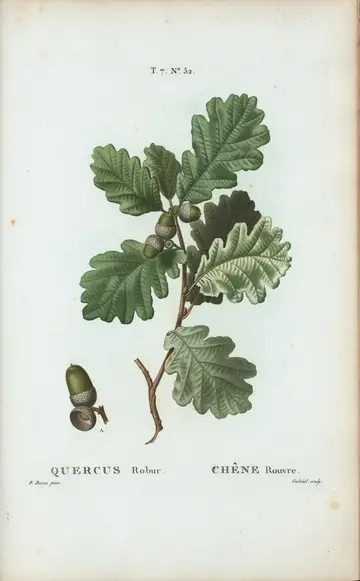
- English oak (Quercus robur): English oak acorns sit on long stalks of 4–8 cm and its leaves have rounded lobes. Turkey oak acorns are stalkless, with shaggy, curled cup scales, and its leaf lobes are bristle-tipped. Compare side by side →
Questions
How do you recognise Turkey oak?
By its acorn cups, covered in long, hair-like scales that curl backwards, and by its leaf lobes, which end in fine bristles.
Turkey oak: when does it flower?
In summer: June. Months are for temperate northern-hemisphere climates and shift with altitude and weather.
Turkey oak: what is its scientific name?
Quercus cerris L., in the genus Quercus and the family Fagaceae.
Sources
- Wikipedia: Quercus cerris
- ASPCA Animal Poison Control: Oak (Quercus species)
- Plants of the World Online (Kew) · native range (WCVP)
- GBIF · classification
- Wikidata
Checked: 2026-11-24. Spotted a mistake? Tell us.