Telling them apart
English oak vs Valonia oak
English oak (Quercus robur) and Valonia oak (Quercus ithaburensis) look similar enough to be confused. Both belong to the same family, Fagaceae (beech family).
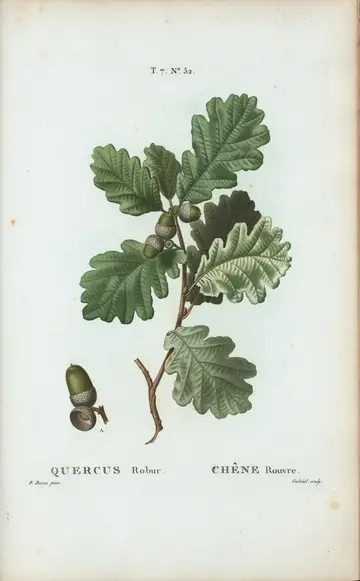
Image wanted. A licensed image will be added when found.
How to tell them apart
- English oak: Deciduous, with deeply lobed, hairless leaves; the scales of its acorn cups are flat and tight.
Side by side
| English oak | Valonia oak | |
|---|---|---|
| Scientific name | Quercus robur | Quercus ithaburensis |
| Family | Fagaceae (beech family) | Fagaceae (beech family) |
| Form | tree, perennial, deciduous | tree, perennial, semi-evergreen |
| Height | 20–40 m | Up to 15 m |
| Flower colour | Green | Green |
| Origin | Europe, the Caucasus and Anatolia | South-eastern Italy to the Levant |
| Toxicity | — | — |
| Flowering | ||
| Leaves | Leaves mostly 10–12 cm, irregularly and roundly lobed, with a very short stalk and small "ear-lobes" at the base. | Oval leaves 4–9 cm long with 7–10 pairs of teeth and down-curled edges; glossy dark green above and grey-felted below. |
| Flowers | Male flowers in hanging, yellowish-green catkins; female flowers small and inconspicuous. They open with the leaves and are wind-pollinated. | Light green male catkins 5 cm long and tiny female flowers in March–April; wind-pollinated. |
| Fruit and seeds | Acorns on a long stalk of 4–8 cm, singly or a few together. A short leaf stalk and a long acorn stalk separate it from the sessile oak. | Oval acorns up to 5 cm long; the cup covers about a third of the acorn and is clothed in long, stiff, backward-curling scales. They ripen in the second autumn after pollination. |
All pairs: look-alike plants · Full pages: English oak, Valonia oak