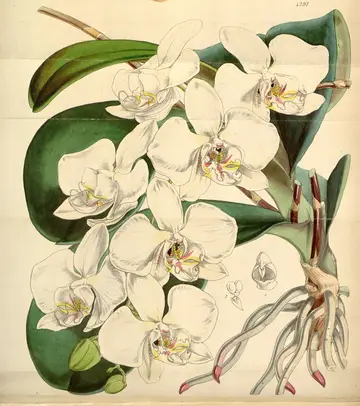
Description
Form
climber (orchid), perennial, evergreen
Height: Climbs trees to 10–15 m
Flower colour
YellowGreen
Flowering
No reliable data in the sources.
Habitat
Leaves
Thick, fleshy, glossy, elliptic leaves set singly along the climbing stem, which clings with aerial roots from its nodes.
Flowers
Pale greenish-yellow, fragrant orchid flowers 5–7 cm across; each stays open for only a few hours or a day.
Fruit and seeds
Thin green capsules 15–25 cm long that turn yellow when ripe, holding thousands of tiny black seeds.
Classification
- KingdomPlantae
- PhylumTracheophyta
- ClassLiliopsida
- OrderAsparagales
- FamilyOrchidaceae
- GenusVanilla
- SpeciesVanilla planifolia
Native range
According to POWO it is native to eastern and southern Mexico, Central America, Colombia and northern Brazil. Today it is grown most of all in Madagascar.
IUCN Red List status: Endangered (EN).
Culture and history
Edmond Albius
Outside Mexico vanilla long failed to fruit because its natural pollinators were absent. In 1841, on the island of Réunion, Edmond Albius, an enslaved 12-year-old, found a simple way to hand-pollinate the flowers with a stick and a finger; the method is still used today.
Look-alikes
- Moth orchid: Same family (orchids), but it does not climb, its leaves form a basal rosette, and it is not grown for fruit. Compare side by side →
Questions
Is vanilla an orchid?
Yes. Vanilla pods are the cured capsules of a climbing orchid, Vanilla planifolia.
Why is vanilla pollinated by hand?
Its natural pollinators live only in Mexico and Central America. On plantations elsewhere each flower is pollinated by hand during the short time it is open.
Vanilla: what is its scientific name?
Vanilla planifolia Andrews, in the genus Vanilla and the family Orchidaceae.
Sources
- Wikipedia: Vanilla planifolia
- World Flora Online
- Plants of the World Online (Kew) · native range (WCVP)
- GBIF · classification
- Wikidata
Checked: 2026-11-17. Spotted a mistake? Tell us.