Description
Form
tree, perennial, deciduous
Height: Usually 24–46 m; up to 58.5 m
Flower colour
YellowGreenOrange
Flowering
April–June
Habitat
Leaves
Alternate, four-lobed leaves 12.5–15 cm long and wide; the tip is cut across at a shallow angle, so the upper part looks square. Bright green and glossy above, paler beneath; they turn clear yellow in autumn.
Flowers
Solitary, upright, cup-shaped, greenish-yellow flowers 4–5 cm long at the branch tips, with an orange band on the tepals. They produce large quantities of nectar.
Classification
- KingdomPlantae
- PhylumTracheophyta
- ClassMagnoliopsida
- OrderMagnoliales
- FamilyMagnoliaceae
- GenusLiriodendron
- SpeciesLiriodendron tulipifera
Native range
According to POWO it is native to eastern North America, from southern Ontario to Illinois and from Massachusetts south to central Florida and Louisiana.
IUCN Red List status: Least concern (LC).
Growing conditions
Soil
Deep, rich, rather moist soil.
Grows fairly fast.
Culture and history
"Midwood"
According to Wikipedia its wood is strong despite its fast growth; in 2024 researchers at the University of Cambridge proposed calling it "midwood", a category distinct from hardwood and softwood.
A state tree
According to Wikipedia it is the state tree of Indiana, Kentucky and Tennessee. The genus has only two species; the other is the Chinese tulip tree (Liriodendron chinense).
Toxicity
ASPCA lists the tulip tree ("Tulip Poplar") as non-toxic to cats, dogs and horses.
In an emergency call your local poison centre; for pets, contact a vet straight away. See also: plants and pets.
Look-alikes
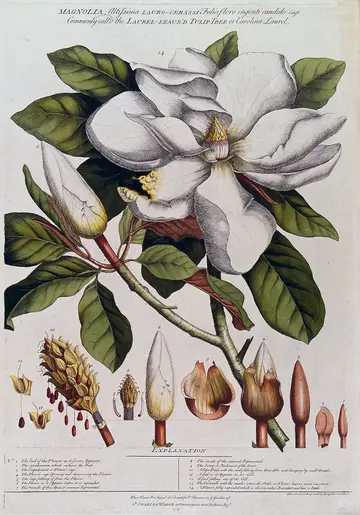
- Southern magnolia (Magnolia grandiflora): Same family, but evergreen, with entire, leathery leaves and creamy white flowers up to 30 cm across. Tulip tree leaves are four-lobed with a flat tip, and its flowers are 4–5 cm and greenish-yellow. Compare side by side →
Questions
Why is it called the tulip tree?
Its upright, cup-shaped, greenish-yellow flowers look like tulips. The epithet tulipifera means "tulip-bearing".
Tulip tree: when does it flower?
In spring and summer: April–June. Months are for temperate northern-hemisphere climates and shift with altitude and weather.
Tulip tree: is it toxic to cats and dogs?
Non-toxic to cats and dogs. Non-toxic.
Tulip tree: what is its scientific name?
Liriodendron tulipifera L., in the genus Liriodendron and the family Magnoliaceae.
Sources
- Wikipedia: Liriodendron tulipifera
- ASPCA Animal Poison Control: Tulip Poplar (Liriodendron tulipifera)
- Plants of the World Online (Kew) · native range (WCVP)
- GBIF · classification
- Wikidata
Checked: 2026-11-24. Spotted a mistake? Tell us.