Telling them apart
Southern magnolia vs Tulip tree
Southern magnolia (Magnolia grandiflora) and Tulip tree (Liriodendron tulipifera) look similar enough to be confused. Both belong to the same family, Magnoliaceae (magnolia family).
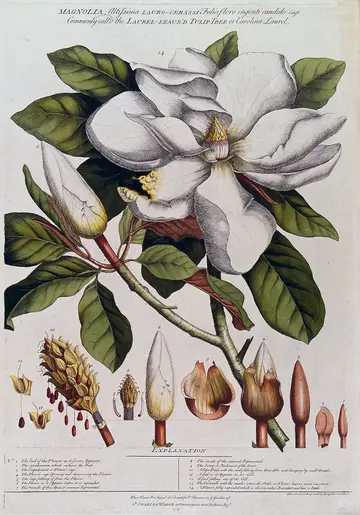
Image wanted. A licensed image will be added when found.
How to tell them apart
- Southern magnolia: Same family, but evergreen, with entire, leathery leaves and creamy white flowers up to 30 cm across. Tulip tree leaves are four-lobed with a flat tip, and its flowers are 4–5 cm and greenish-yellow.
Side by side
| Southern magnolia | Tulip tree | |
|---|---|---|
| Scientific name | Magnolia grandiflora | Liriodendron tulipifera |
| Family | Magnoliaceae (magnolia family) | Magnoliaceae (magnolia family) |
| Form | tree, perennial, evergreen | tree, perennial, deciduous |
| Height | 15–30 m; the largest specimens 37 m | Usually 24–46 m; up to 58.5 m |
| Flower colour | White | Yellow, Green, Orange |
| Origin | Southeastern United States | Eastern North America |
| Toxicity | Cats: non-toxic · Dogs: non-toxic | Cats: non-toxic · Dogs: non-toxic |
| Flowering | ||
| Leaves | Thick, leathery, smooth-edged leaves 12–20 cm long and 6–12 cm wide, glossy dark green above and often rusty-hairy underneath. | Alternate, four-lobed leaves 12.5–15 cm long and wide; the tip is cut across at a shallow angle, so the upper part looks square. Bright green and glossy above, paler beneath; they turn clear yellow in autumn. |
| Flowers | Creamy-white flowers up to 30 cm across with 6–12 thick, waxy tepals and a strong, lemony scent, borne at the branch tips of mature trees. | Solitary, upright, cup-shaped, greenish-yellow flowers 4–5 cm long at the branch tips, with an orange band on the tepals. They produce large quantities of nectar. |
| Fruit and seeds | A pinkish-red, egg-shaped cluster of follicles 7.5–10 cm long that opens to dangle bright red seeds, spread by birds and mammals. | — |
All pairs: look-alike plants · Full pages: Southern magnolia, Tulip tree