Description
Form
tree, perennial, evergreen
Height: 15–30 m; the largest specimens 37 m
Flower colour
White
Flowering
May–July
Habitat
Leaves
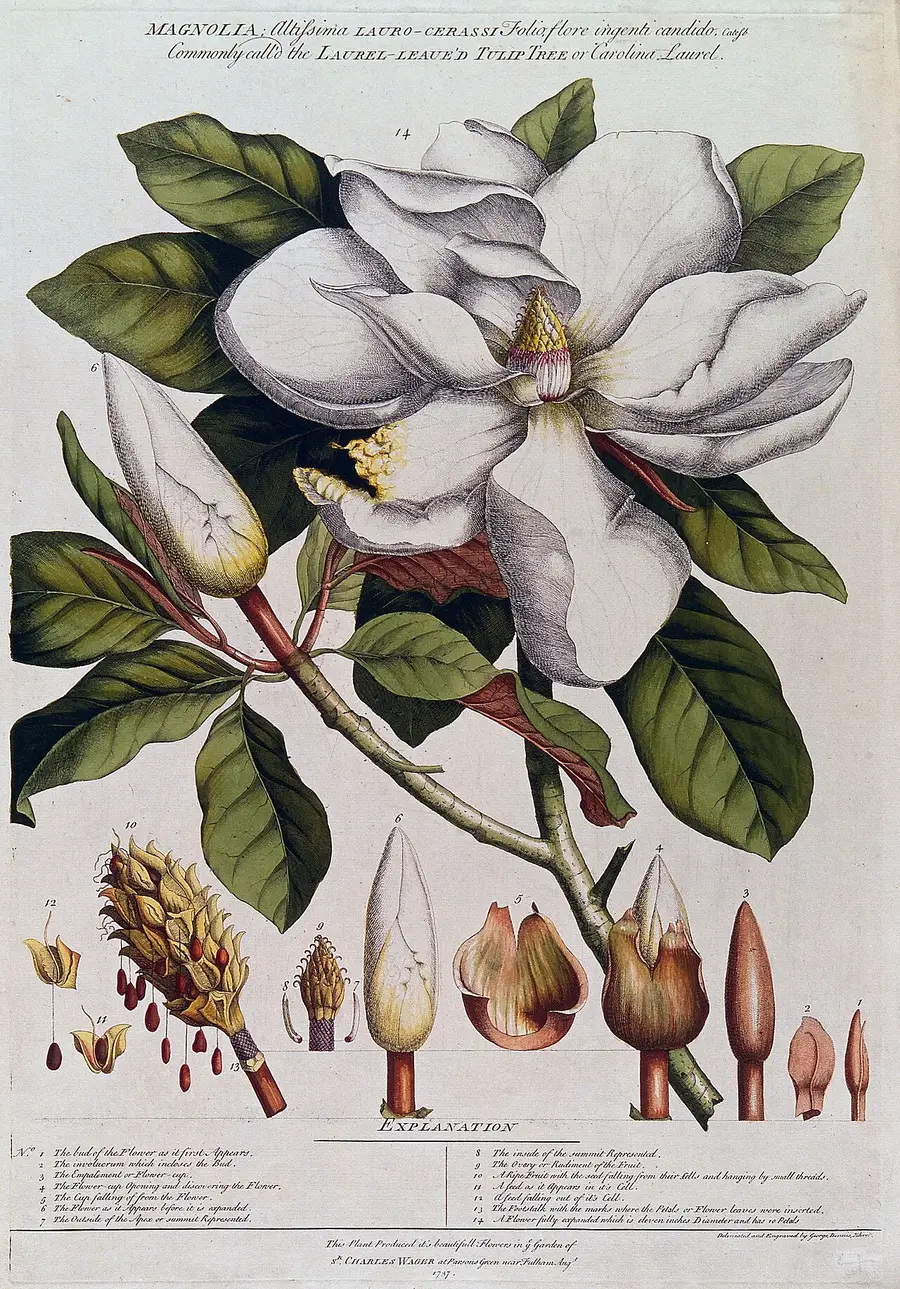
Thick, leathery, smooth-edged leaves 12–20 cm long and 6–12 cm wide, glossy dark green above and often rusty-hairy underneath.
Flowers
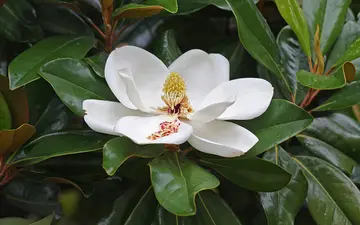
Creamy-white flowers up to 30 cm across with 6–12 thick, waxy tepals and a strong, lemony scent, borne at the branch tips of mature trees.
Fruit and seeds
A pinkish-red, egg-shaped cluster of follicles 7.5–10 cm long that opens to dangle bright red seeds, spread by birds and mammals.
Classification
- KingdomPlantae
- PhylumTracheophyta
- ClassMagnoliopsida
- OrderMagnoliales
- FamilyMagnoliaceae
- GenusMagnolia
- SpeciesMagnolia grandiflora
Native range
According to POWO it is native to the southeastern United States, from North Carolina to Florida and Texas. It is a common ornamental in temperate regions.
IUCN Red List status: Least concern (LC).
Growing conditions
Light
Sun or partial shade.
Water
Moderate; likes deep, moist soil.
Soil
Slightly acid to neutral, humus-rich soil.
Temperature
Likes mild winters; hard frost damages the leaves.
Tolerates air pollutants such as sulphur dioxide, so it is often planted in cities. Grown against a wall, it copes better with cold.
Culture and history
An ancient lineage
Magnolias are among the oldest lineages of flowering plants; they evolved before bees appeared and are pollinated mainly by beetles, which is why their flower parts are tough.
The name
The genus honours the French botanist Pierre Magnol; "grandiflora" means "large-flowered". It was brought to Europe in the 1720s.
Toxicity
ASPCA lists magnolia (entry under Magnolia stellata) as non-toxic to cats, dogs and horses.
In an emergency call your local poison centre; for pets, contact a vet straight away. See also: plants and pets.
Look-alikes
- Deciduous magnolias (Magnolia × soulangeana and others): Bear pink-white, tulip-shaped flowers on bare branches in spring before the leaves.
Questions
Is southern magnolia evergreen?
Yes. Unlike the spring-flowering deciduous magnolias, it keeps its glossy leaves all year and flowers in summer.
Southern magnolia: when does it flower?
In spring and summer: May–July. Months are for temperate northern-hemisphere climates and shift with altitude and weather.
Southern magnolia: how do you grow it?
Light: Sun or partial shade. Water: Moderate; likes deep, moist soil. Soil: Slightly acid to neutral, humus-rich soil. Temperature: Likes mild winters; hard frost damages the leaves. Tolerates air pollutants such as sulphur dioxide, so it is often planted in cities. Grown against a wall, it copes better with cold.
Southern magnolia: is it toxic to cats and dogs?
Non-toxic to cats and dogs. Listed as non-toxic.
Southern magnolia: what is its scientific name?
Magnolia grandiflora L., in the genus Magnolia and the family Magnoliaceae.
Sources
- Wikipedia: Magnolia grandiflora
- World Flora Online
- Plants of the World Online (Kew) · native range (WCVP)
- GBIF · classification
- Wikidata
- ASPCA Animal Poison Control: Magnolia Bush (Magnolia stellata)
Checked: 2026-11-16. Spotted a mistake? Tell us.