Description
Form
succulent, perennial, evergreen
Height: 2–5 m
Flower colour
YellowOrange
Flowering
May–June
Leaves
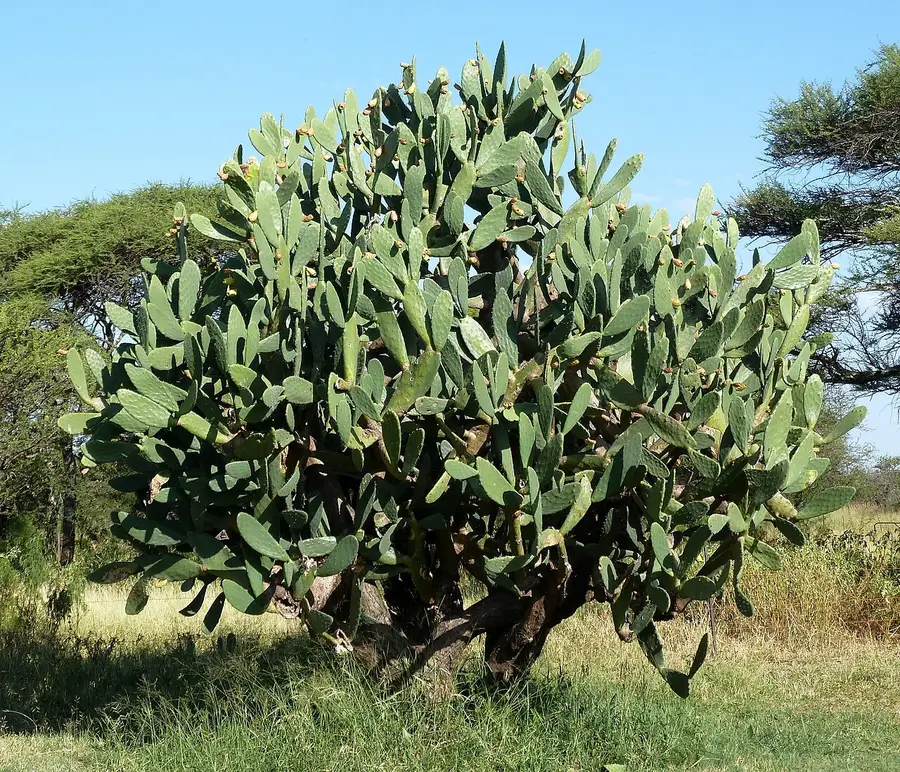
The true leaves are tiny and drop early. The green, flat "paddles" are stem segments (cladodes). Their dots carry stiff spines and very fine, barbed bristles (glochids) that break off easily and lodge in the skin.
Flowers
Silky, cup-shaped yellow or orange flowers along the edges of the paddles.
Fruit and seeds
An egg-shaped, fleshy, sweet fruit ranging from green to red-purple; its skin carries fine bristles, so it should not be handled before peeling.
Classification
- KingdomPlantae
- PhylumTracheophyta
- ClassMagnoliopsida
- OrderCaryophyllales
- FamilyCactaceae
- GenusOpuntia
- SpeciesOpuntia ficus-indica
Native range
POWO gives its native range as south-western Mexico. DNA studies suggest it was domesticated from wild Opuntia species in central Mexico. It spread through the Americas before Columbus and then to warm regions worldwide; it has naturalised around the Mediterranean and is considered invasive in North Africa.
IUCN Red List status: Data deficient (DD).
Growing conditions
Light
Full sun.
Water
Very drought tolerant.
Soil
Poor, stony, free-draining soil.
Temperature
Tolerates light frost.
Paddles planted in the soil root easily. Wear thick gloves because of the bristles.
Culture and history
On the arms of Mexico
The coat of arms and flag of Mexico show an eagle eating a snake while perched on a prickly pear, from the founding legend of the Aztec capital Tenochtitlan.
Red dye
Since before Columbus, red and purple dye (carmine) has been made from cochineal insects that live on this cactus.
Look-alikes
- Century plant: Seen in the same coastal places, but not a cactus: it forms a rosette of long, sharp-tipped leaves. Compare side by side →
Questions
Why are prickly pear fruits hard to handle?
The fine bristles on the skin break off and lodge in the skin. Never hold the fruit with bare hands; gloves or tongs are needed.
Prickly pear: when does it flower?
In spring and summer: May–June. Months are for temperate northern-hemisphere climates and shift with altitude and weather.
Prickly pear: how do you grow it?
Light: Full sun. Water: Very drought tolerant. Soil: Poor, stony, free-draining soil. Temperature: Tolerates light frost. Wear thick gloves because of the bristles.
Prickly pear: how do you propagate it?
Paddles planted in the soil root easily.
Prickly pear: what is its scientific name?
Opuntia ficus-indica (L.) Mill., in the genus Opuntia and the family Cactaceae.
Sources
- Wikipedia: Opuntia ficus-indica
- World Flora Online
- Plants of the World Online (Kew) · native range (WCVP)
- GBIF · classification
- Wikidata
Checked: 2026-11-16. Spotted a mistake? Tell us.