Telling them apart
Century plant vs Prickly pear
Century plant (Agave americana) and Prickly pear (Opuntia ficus-indica) look similar enough to be confused. They belong to different families: Asparagaceae (asparagus family) and Cactaceae (cactus family).
How to tell them apart
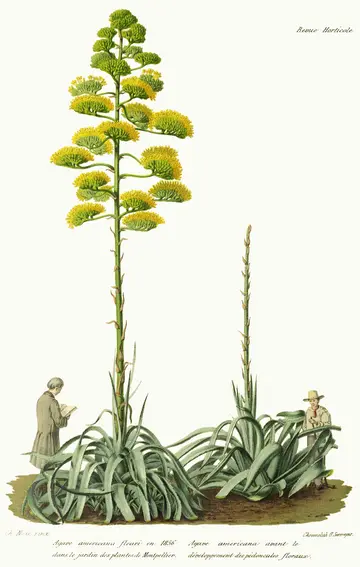
- Century plant: Seen in the same coastal places, but not a cactus: it forms a rosette of long, sharp-tipped leaves.
Side by side
| Century plant | Prickly pear | |
|---|---|---|
| Scientific name | Agave americana | Opuntia ficus-indica |
| Family | Asparagaceae (asparagus family) | Cactaceae (cactus family) |
| Form | succulent, perennial, evergreen | succulent, perennial, evergreen |
| Height | Rosette 1–2 m; flowering stalk 5–8 m | 2–5 m |
| Flower colour | Yellow | Yellow, Orange |
| Origin | Mexico and the south-western United States | Mexico |
| Toxicity | People: mildly toxic / irritant | — |
| Flowering | ||
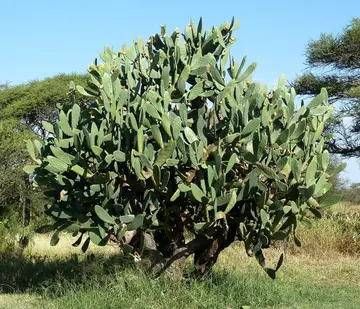
| Leaves | Thick leaves 1–2 m long, grey-blue or edged with yellow; the margins carry hooked teeth and each leaf ends in a very hard, sharp spine. | The true leaves are tiny and drop early. The green, flat "paddles" are stem segments (cladodes). Their dots carry stiff spines and very fine, barbed bristles (glochids) that break off easily and lodge in the skin. |
| Flowers | When the plant is 10–30 years old, a giant, tree-like branched stalk rises from the centre of the rosette, with clusters of yellow flowers at the branch tips. | Silky, cup-shaped yellow or orange flowers along the edges of the paddles. |
| Fruit and seeds | Capsules; the plant can also produce small plantlets on the flowering stalk. | An egg-shaped, fleshy, sweet fruit ranging from green to red-purple; its skin carries fine bristles, so it should not be handled before peeling. |
All pairs: look-alike plants · Full pages: Century plant, Prickly pear