Description
Form
herbaceous, annual
Height: 0.4–1.5 m
Flower colour
Purple
Flowering
No reliable data in the sources.
Leaves
Large, oval leaves with wavy or lobed edges, hairy underneath; some varieties have spines on the stems and leaf veins.
Flowers
Purple, five-pointed flowers with yellow anthers in the centre.
Fruit and seeds
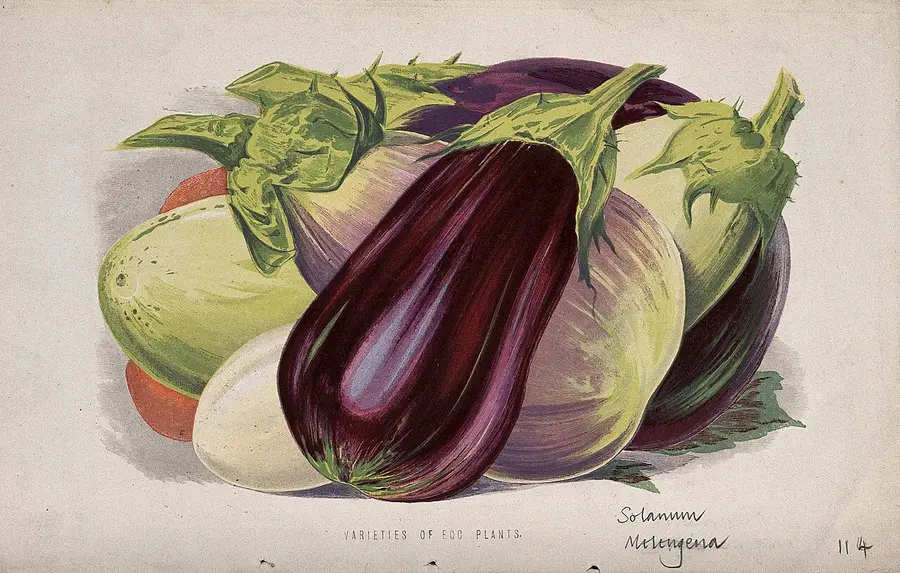
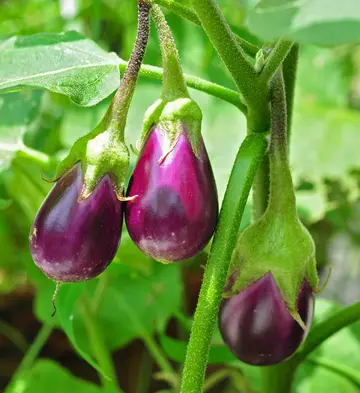
Botanically a large berry; purple, near-black, white, green or streaked, long or round depending on the variety.
Classification
- KingdomPlantae
- PhylumTracheophyta
- ClassMagnoliopsida
- OrderSolanales
- FamilySolanaceae
- GenusSolanum
- SpeciesSolanum melongena
Native range
According to POWO it is native to India, Pakistan, the Himalaya, Bangladesh, Sri Lanka, Myanmar, Thailand, Laos, southern China, the Malay Peninsula, Indonesia and the Philippines, as well as Madagascar and the Mascarenes. It was domesticated in Asia.
Growing conditions
Light
Full sun.
Water
Regular watering.
Soil
Free-draining, fertile soil.
Temperature
Loves heat; sensitive to frost and cool nights.
Culture and history
Journey to the Mediterranean
The aubergine was domesticated in Asia and reached the Mediterranean world in the Middle Ages through the Arabs; many of its European names come from the Arabic "bādhinjān".
Look-alikes
- Tomato: Same genus, with yellow flowers and compound leaves. Compare side by side →
Questions
Is aubergine a fruit or a vegetable?
Botanically a fruit (a berry); in the kitchen it is used as a vegetable.
Where does the aubergine come from?
From tropical Asia; POWO treats it as native from India to Southeast Asia and southern China.
Aubergine: how do you grow it?
Light: Full sun. Water: Regular watering. Soil: Free-draining, fertile soil. Temperature: Loves heat; sensitive to frost and cool nights.
Aubergine: what is its scientific name?
Solanum melongena L., in the genus Solanum and the family Solanaceae.
Sources
- Wikipedia: Eggplant
- World Flora Online
- Plants of the World Online (Kew) · native range (WCVP)
- GBIF · classification
- Wikidata
Checked: 2026-11-16. Spotted a mistake? Tell us.