Description
Leaves
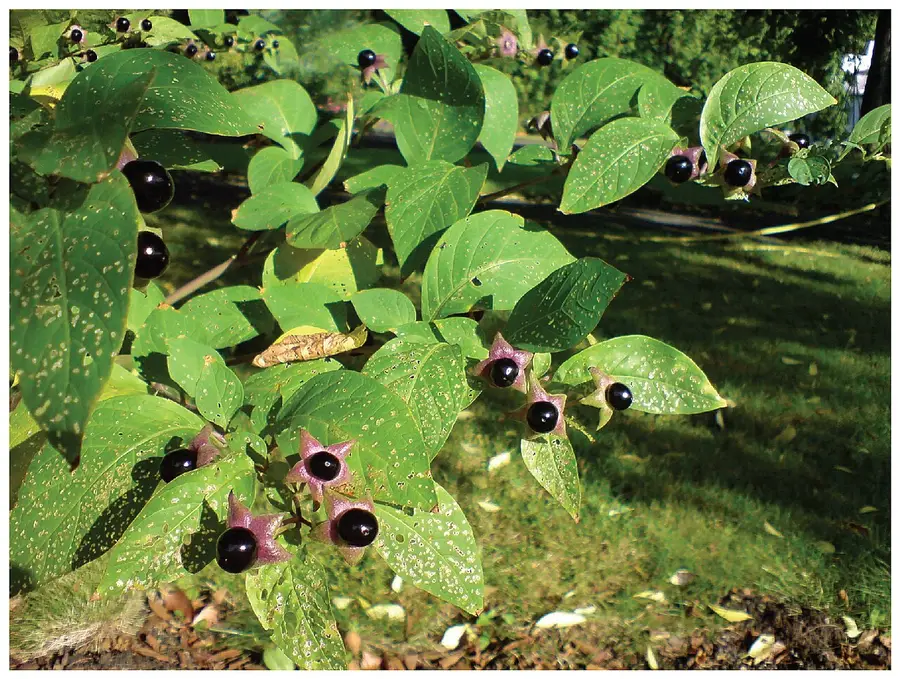
Large, oval, smooth-edged, soft leaves.
Flowers
Single, nodding, bell-shaped purple-brown flowers in the leaf axils.
Fruit and seeds
A glossy black berry the size of a cherry, sitting on a star-shaped green calyx.
Classification
- KingdomPlantae
- PhylumTracheophyta
- ClassMagnoliopsida
- OrderSolanales
- FamilySolanaceae
- GenusAtropa
- SpeciesAtropa bella-donna
Native range
According to POWO it is native to central and southern Europe, North Africa (Morocco, Algeria), Türkiye, the Caucasus, Lebanon–Syria and Iran.
Culture and history
The name
"Bella donna" is Italian for "beautiful lady": in Renaissance Italy women are said to have used drops of the plant to enlarge their pupils. The genus Atropa is named after Atropos, the Fate who cuts the thread of life in Greek myth.
Toxicity
All parts contain tropane alkaloids such as atropine, scopolamine and hyoscyamine. Signs of poisoning include dilated pupils, dry mouth, flushing, racing heart, confusion and hallucinations; it can be fatal. Even a few berries are dangerous for children. Never pick or eat a wild plant unless you are certain what it is. If poisoning is suspected, call your local poison centre or emergency number at once.
In an emergency call your local poison centre; for pets, contact a vet straight away. See also: plants and pets.
Look-alikes
- Blackberries and bilberries: The black fruit can be confused. A deadly nightshade berry is single and glossy and sits on a star-shaped calyx; a blackberry is made of many small drupelets.
- Black nightshade (Solanum nigrum): A weed of the same family with small black berries and white flowers; it can also be poisonous.
Questions
Is deadly nightshade poisonous?
Yes, highly. Every part contains atropine and related alkaloids; even a few berries can seriously poison a child.
Deadly nightshade: when does it flower?
In summer: June–August. Months are for temperate northern-hemisphere climates and shift with altitude and weather.
Deadly nightshade: what is its scientific name?
Atropa bella-donna L., in the genus Atropa and the family Solanaceae.
Sources
- Wikipedia: Atropa belladonna
- World Flora Online
- GBIF · classification
Checked: 2026-11-16. Spotted a mistake? Tell us.