Telling them apart
Pecan vs Common walnut
Pecan (Carya illinoinensis) and Common walnut (Juglans regia) look similar enough to be confused. Both belong to the same family, Juglandaceae (walnut family).
Image wanted. A licensed image will be added when found.
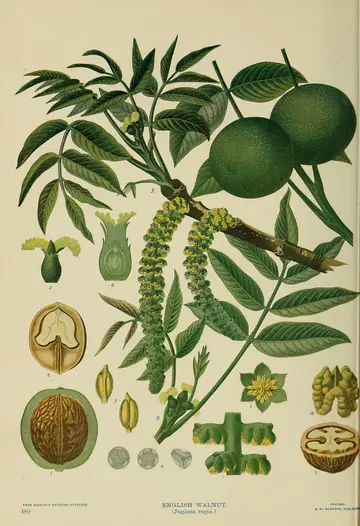
How to tell them apart
- Common walnut: Same family (walnut family). Walnut leaves are 20–45 cm with mostly 5–9 leaflets, and its green husk blackens and cracks to reveal a wrinkled, hard-shelled nut. Pecan leaves have 9–17 leaflets and its shell is thin and smooth.
Side by side
| Pecan | Common walnut | |
|---|---|---|
| Scientific name | Carya illinoinensis | Juglans regia |
| Family | Juglandaceae (walnut family) | Juglandaceae (walnut family) |
| Form | tree, perennial, deciduous | tree, perennial, deciduous |
| Height | — | 10–25 m |
| Flower colour | — | Green |
| Origin | South-central USA and Mexico | Türkiye to Central Asia |
| Toxicity | — | — |
| Flowering | — | |
| Leaves | Alternate, pinnate leaves 30–45 cm long with 9–17 leaflets, each 5–12 cm long and 2–6 cm wide. | Compound leaves 20–45 cm long with 5–9 (most often 7) oval leaflets, strongly and pleasantly aromatic when crushed. |
| Flowers | — | Male flowers in long, hanging green catkins; female flowers 2–5 at the shoot tips, small and hairy. Wind-pollinated. |
| Fruit and seeds | Botanically not a true nut but a drupe: a husk 3–4 mm thick, green at first and brown when ripe, splits into four sections to release the thin-shelled seed. | A hard, wrinkled nut inside a green, fleshy husk that blackens and splits when ripe; the husk stains hands brown. |
All pairs: look-alike plants · Full pages: Pecan, Common walnut