Description
Form
herbaceous, biennial
Height: Flowering stem up to 75 cm
Flower colour
YellowGreen
Flowering
No reliable data in the sources.
Leaves
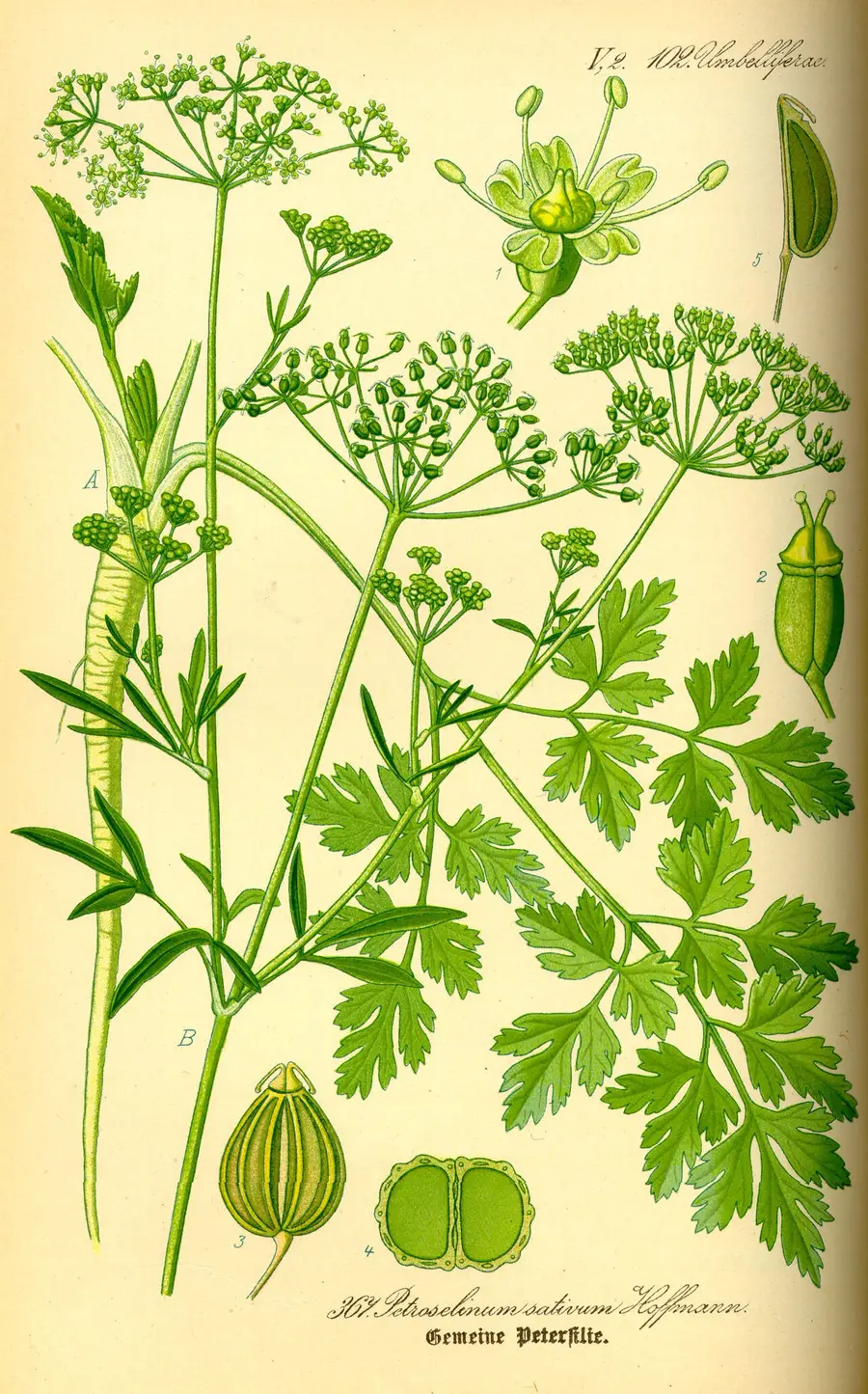
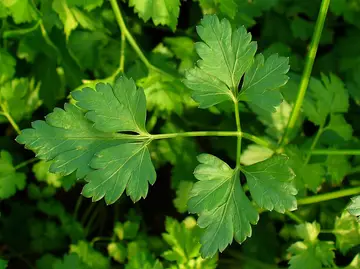
In the first year a rosette of three-times divided leaves 10–25 cm long. Leaflets 1–3 cm; their edges curl in curly varieties.
Flowers
In the second year the stem carries flat-topped umbrella-shaped heads 3–10 cm across, with tiny (2 mm) yellow or yellowish-green flowers.
Fruit and seeds
Egg-shaped seeds 2–3 mm long (botanically a dry fruit that splits in two).
Classification
- KingdomPlantae
- PhylumTracheophyta
- ClassMagnoliopsida
- OrderApiales
- FamilyApiaceae
- GenusPetroselinum
- SpeciesPetroselinum crispum
Native range
According to POWO it is native to Greece, the north-western Balkans, Algeria and Morocco. It has naturalised across most of Europe and in many suitable climates worldwide.
Growing conditions
Light
Sun or part shade.
Water
Regular.
Soil
Moist, fertile, free-draining soil.
Temperature
Grows well in the cool season; tolerates light frost.
Grown from seed; the seeds germinate slowly and unevenly.
Culture and history
The name
Petroselinum comes from the Greek petroselinon, "rock celery". The English parsley and German Petersilie come from the same root.
Toxicity
ASPCA lists parsley as toxic to cats, dogs and horses. The toxins are furanocoumarins, which can cause photosensitivity (sunburn, skin inflammation). According to ASPCA a large amount must be eaten for this effect.
In an emergency call your local poison centre; for pets, contact a vet straight away. See also: plants and pets.
Look-alikes
- Fool's parsley (Aethusa cynapium): A poisonous wild plant of the carrot family that closely resembles parsley. Long, thin bracts hang down beneath its flower heads. Never pick wild plants of the carrot family.
- Poison hemlock (Conium maculatum): Deadly poisonous member of the same family, with white umbrella-shaped flower heads too; it is much taller, its stem is smooth with purple blotches and it smells foul when crushed. Never pick wild plants of the carrot family. Compare side by side →
- Coriander (Coriandrum sativum): Its lower leaves look like flat-leaf parsley, but the smell is completely different. Compare side by side →
Questions
How long does parsley live?
It is biennial: a leaf rosette in the first year, a flowering stem in the second, and it dies after setting seed. For the kitchen it is mostly harvested in the first year.
Is parsley toxic to cats and dogs?
ASPCA lists parsley as toxic to cats, dogs and horses. Its furanocoumarins can cause photosensitivity; according to ASPCA a large amount must be eaten for this.
Parsley: how do you grow it?
Light: Sun or part shade. Water: Regular. Soil: Moist, fertile, free-draining soil. Temperature: Grows well in the cool season; tolerates light frost.
Parsley: how do you propagate it?
Grown from seed; the seeds germinate slowly and unevenly.
Parsley: what is its scientific name?
Petroselinum crispum (Mill.) Fuss, in the genus Petroselinum and the family Apiaceae.
Sources
- Wikipedia: Parsley
- World Flora Online
- Plants of the World Online (Kew) · native range (WCVP)
- GBIF · classification
- Wikidata
- ASPCA Animal Poison Control: Parsley
Checked: 2026-11-17. Spotted a mistake? Tell us.