Description
Form
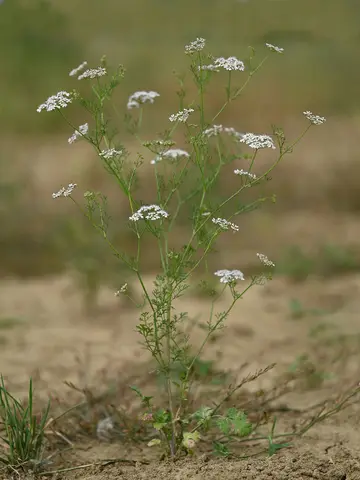
herbaceous, annual
Height: Up to 50 cm
Flower colour
WhitePink
Flowering
No reliable data in the sources.
Leaves
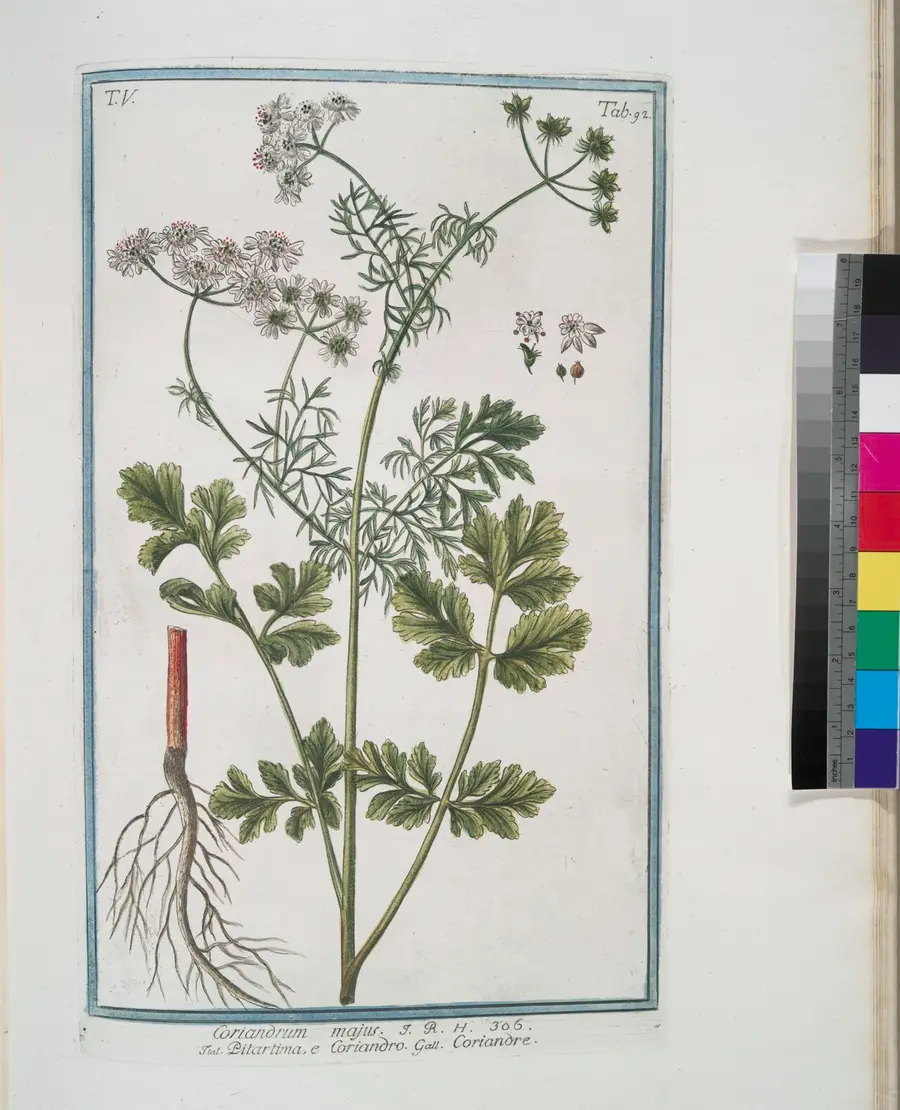
Variable leaves: the lower ones are broad and lobed, those higher on the flowering stem fine and feathery.
Flowers
White or very pale pink flowers in small umbrella-shaped heads. The petals facing outwards (5–6 mm) are much longer than those facing inwards (1–3 mm).
Fruit and seeds
A round, dry fruit 3–5 mm across; this is the "coriander seed" used as a spice.
Classification
- KingdomPlantae
- PhylumTracheophyta
- ClassMagnoliopsida
- OrderApiales
- FamilyApiaceae
- GenusCoriandrum
- SpeciesCoriandrum sativum
Native range
According to POWO it is native to Türkiye, Syria-Lebanon, Palestine, Sinai, Saudi Arabia, the Caucasus, Iran, Afghanistan and Pakistan. Wikipedia gives a Mediterranean origin. It is now grown all over the world.
Growing conditions
Light
Sun or part shade.
Water
Regular.
Soil
Free-draining, fertile soil.
Temperature
Grows well in the cool season; in heat it quickly runs to flower and leaf yield falls.
Culture and history
The soapy taste
Coriander leaves do not taste the same to everyone. Some people liken them to soap or to something rotten. This difference in perception has been partly linked to variation in an odour-receptor gene called OR6A2.
Toxicity
ASPCA lists coriander as non-toxic to cats, dogs and horses.
In an emergency call your local poison centre; for pets, contact a vet straight away. See also: plants and pets.
Look-alikes
- Flat-leaf parsley (Petroselinum crispum): Its leaves resemble coriander's lower leaves but are glossier and more sharply toothed; the smell is different. Compare side by side →
Questions
Why does coriander taste like soap to some people?
The difference has been partly linked to variation in an odour-receptor gene called OR6A2. People with certain forms of the gene may find the leaves smell like soap.
Is coriander native to Türkiye?
POWO includes Türkiye in the native range of coriander.
Coriander: how do you grow it?
Light: Sun or part shade. Water: Regular. Soil: Free-draining, fertile soil. Temperature: Grows well in the cool season; in heat it quickly runs to flower and leaf yield falls.
Coriander: is it toxic to cats and dogs?
Non-toxic to cats and dogs. Non-toxic to pets (ASPCA).
Coriander: what is its scientific name?
Coriandrum sativum L., in the genus Coriandrum and the family Apiaceae.
Sources
- Wikipedia: Coriander
- World Flora Online
- Plants of the World Online (Kew) · native range (WCVP)
- GBIF · classification
- Wikidata
- ASPCA Animal Poison Control: Cilantro
Checked: 2026-11-17. Spotted a mistake? Tell us.