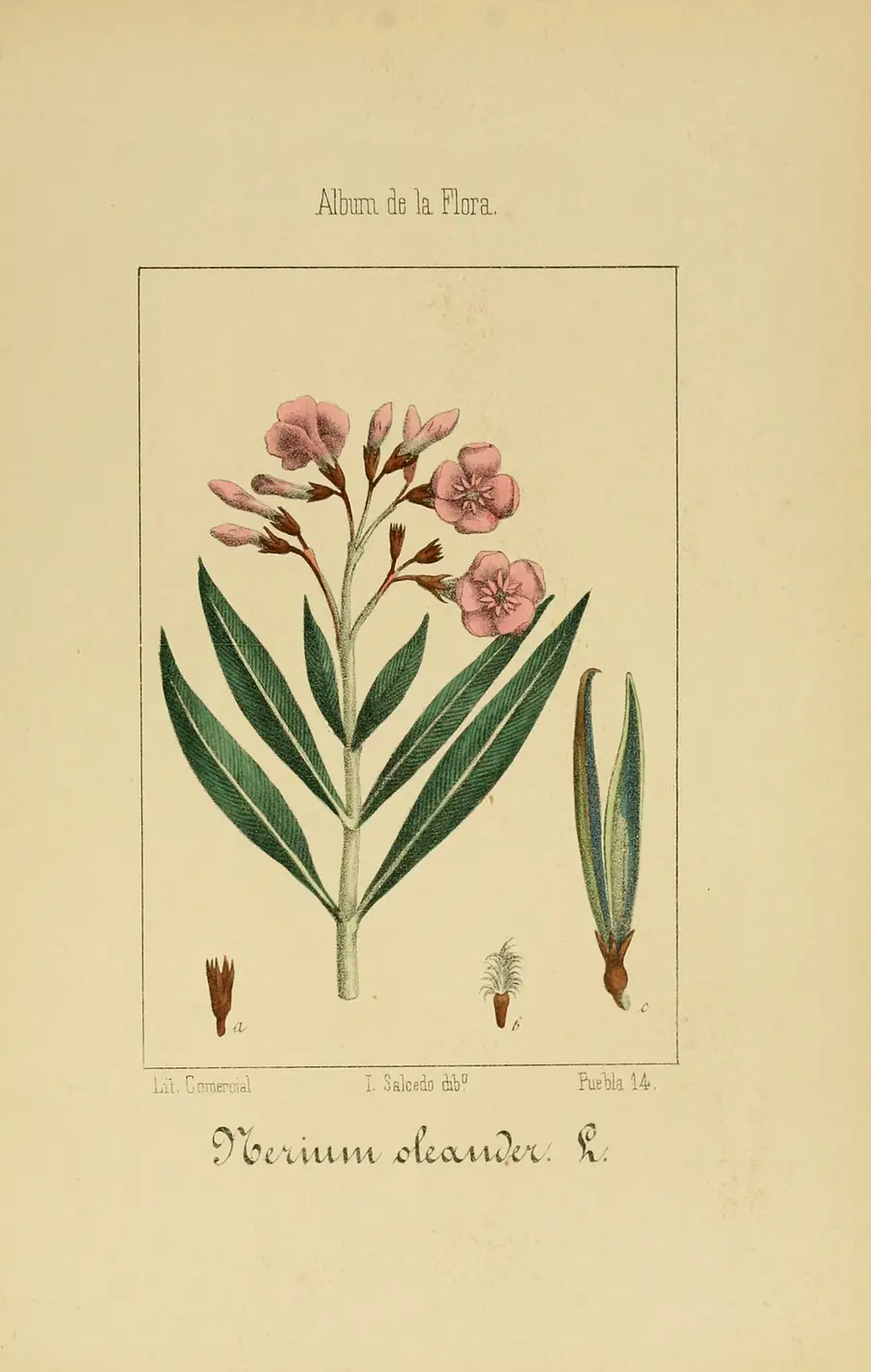

Description
Form
shrub, perennial, evergreen
Height: 2–5 m
Flower colour
PinkWhiteRed
Flowering
May–October
Leaves
Narrow, leathery, dark green leaves, usually in whorls of three.
Flowers
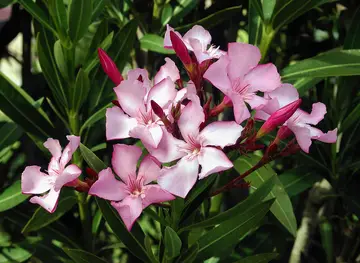
Clusters of five-petalled pink, white, red or yellow flowers at the branch tips; double forms exist.
Fruit and seeds
A long, slender, two-part capsule releasing hairy seeds.

Classification
- KingdomPlantae
- PhylumTracheophyta
- ClassMagnoliopsida
- OrderGentianales
- FamilyApocynaceae
- GenusNerium
- SpeciesNerium oleander
Native range
According to POWO it is native to the Mediterranean Basin (North Africa, southern Europe, Türkiye, the Levant) and from there to Iran, Afghanistan, India and Myanmar, along stream beds in dry regions.
IUCN Red List status: Least concern (LC).
Growing conditions
Light
Full sun.
Water
Very drought tolerant.
Soil
Not fussy.
Temperature
Tolerates light frost.
Wear gloves when pruning and never burn the cuttings; the smoke is harmful. Do not plant where children or pets can reach it.
Toxicity
All parts, including dry leaves, contain cardiac glycosides such as oleandrin. Eating it can cause heart rhythm disturbances and death. ASPCA lists signs in cats, dogs and horses as drooling, abdominal pain, diarrhoea, colic, depression and death. Do not use the stems as skewers and do not burn them.
In an emergency call your local poison centre; for pets, contact a vet straight away. See also: plants and pets.
Look-alikes
- Bay laurel: Also has leathery, lance-shaped leaves, but they are alternate and smell pleasantly when crushed; oleander leaves are in threes and have no scent. Compare side by side →
Questions
How poisonous is oleander?
Very. Every part contains cardiac glycosides; it is dangerous to people, cats, dogs and horses and can be fatal.
Oleander: when does it flower?
In spring and summer and autumn: May–October. Months are for temperate northern-hemisphere climates and shift with altitude and weather.
Oleander: how do you grow it?
Light: Full sun. Water: Very drought tolerant. Soil: Not fussy. Temperature: Tolerates light frost. Do not plant where children or pets can reach it.
Oleander: how do you propagate it?
Wear gloves when pruning and never burn the cuttings; the smoke is harmful.
Oleander: what is its scientific name?
Nerium oleander L., in the genus Nerium and the family Apocynaceae.
Sources
- ASPCA Animal Poison Control: Oleander
- Wikipedia: Nerium
- World Flora Online
- Plants of the World Online (Kew) · native range (WCVP)
- GBIF · classification
- Wikidata
Checked: 2026-11-16. Spotted a mistake? Tell us.